The Audi Quattro: How Four-Wheel Drive Conquered Rally

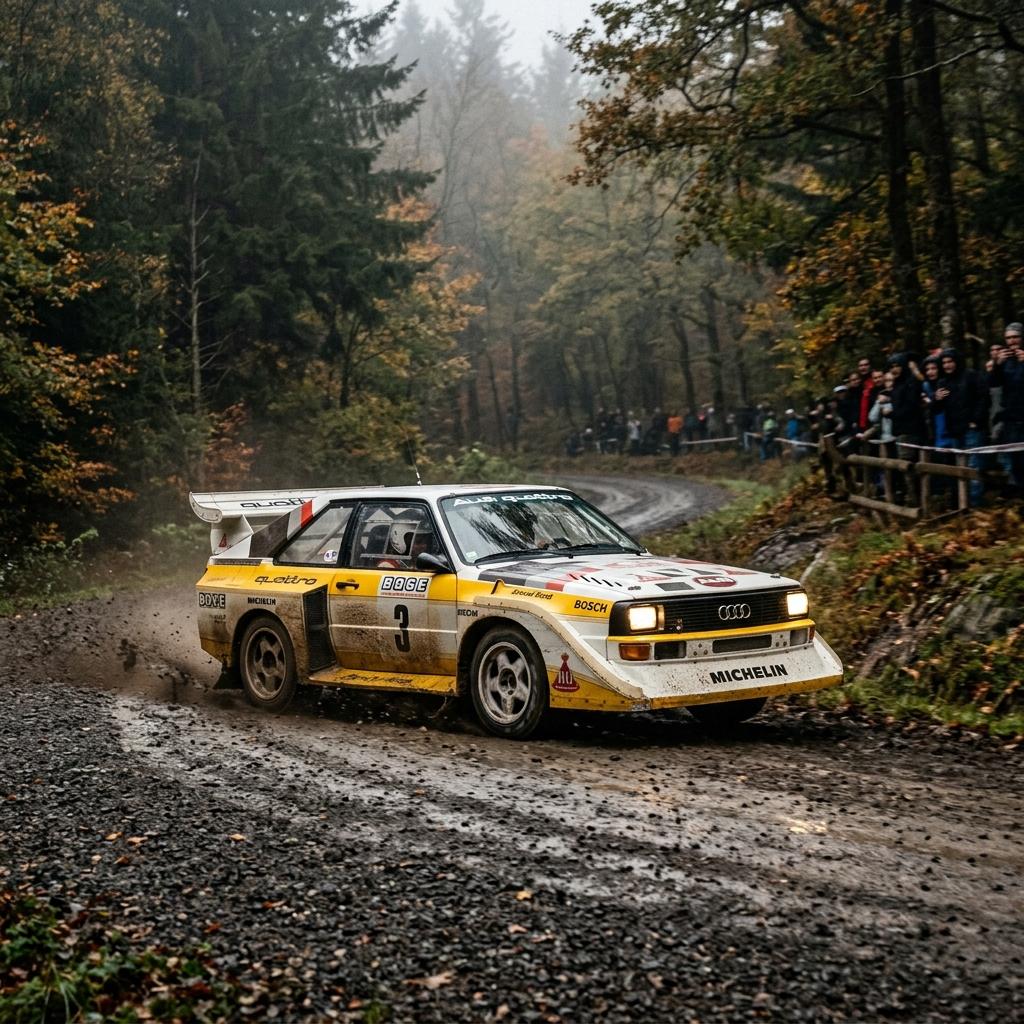
When Audi brought four-wheel drive to rally in 1980, it was deemed cheating. Two years later, everyone had followed.
Before 1980, the concept of a high-performance, all-wheel-drive passenger car was virtually nonexistent. Four-wheel drive was strictly reserved for heavy, utilitarian off-road vehicles like Jeeps and Land Rovers. Audi, a relatively understated German manufacturer at the time, decided to challenge this convention. The result was the Audi Quattro, a car that didn't just introduce a new technology; it completely revolutionized the automotive industry, dominating international rallying and permanently changing how performance cars were engineered.
The Ur-Quattro
The idea for the Quattro was born during the winter testing of the Volkswagen Iltis, a military off-road vehicle. Audi engineer Jörg Bensinger noted that the low-powered, four-wheel-drive Iltis was vastly superior in the snow than Audi's most powerful, front-wheel-drive sedans. He proposed transferring the four-wheel-drive system into an Audi 80 chassis.
Following successful secret prototypes, Audi convinced the board to greenlight production. The original car, unveiled at the 1980 Geneva Motor Show, is often referred to as the "Ur-Quattro" (Ur meaning "original" or "first" in German). It featured aggressive, boxy fender flares, a turbocharged engine, and, crucially, a permanent all-wheel-drive system with a manually lockable center differential.
The Four-Wheel Drive Revolution
The engineering genius of the Audi Quattro was its packaging. Traditional four-wheel-drive systems required a heavy, separate transfer case, which was completely unsuitable for a sports coupe.
Audi engineers devised a brilliantly simple solution: a hollow secondary shaft within the gearbox. Power from the engine went into the gearbox, and the hollow shaft transmitted power to the center differential, which then split the power between the front and rear axles. This layout was lightweight, incredibly compact, and highly efficient, proving that all-wheel drive could be successfully applied to high-performance road cars.
Group B Dominance
Audi didn't just build the Quattro for the road; they built it to conquer the World Rally Championship. In 1981, they entered the WRC, and the impact was immediate and devastating to the competition.
Prior to the Quattro, rally cars were exclusively rear-wheel drive. On the snow, ice, and loose gravel of rally stages, the two-wheel-drive cars struggled for traction. The Quattro, however, clawed into the dirt, utilizing all four tires to pull itself out of corners with astonishing speed. Driven by legends like Hannu Mikkola, Stig Blomqvist, and Michèle Mouton (who became the first and only woman to win a WRC event), the Quattro decimated the opposition, winning the Manufacturers' Championship in 1982 and 1984.
As the Group B regulations escalated, the Quattro evolved into the terrifyingly fast Sport Quattro S1 E2, featuring a shortened wheelbase, massive aerodynamic wings, and nearly 600 horsepower, becoming the defining icon of the Group B era.
The Five-Cylinder Engine
Matching the revolutionary drivetrain was a unique and characterful powerplant. The Quattro was powered by a longitudinally mounted, 2.1-liter (later 2.2-liter) inline-five cylinder turbocharged engine.
The inline-five configuration offered a perfect compromise: it was smoother and more powerful than a four-cylinder, but shorter and lighter than an inline-six, allowing it to fit ahead of the front axle. It produced 200 horsepower in road trim. More importantly, the firing order of the five-cylinder engine produced a highly distinctive, off-beat, aggressive burble that became the unmistakable auditory signature of Audi's rally dominance.
Legacy of the Quattro
The success of the Audi Quattro fundamentally changed the performance car landscape. Within a few years, virtually every major rally team abandoned rear-wheel drive and rushed to develop their own all-wheel-drive systems (leading to cars like the Peugeot 205 T16 and Lancia Delta Integrale).
For the consumer market, the Quattro proved that all-wheel drive offered immense benefits in safety, handling, and all-weather performance. Today, Audi's "quattro" badge is appended to millions of vehicles, and high-performance all-wheel-drive systems are the standard for hypercars and super-sedans worldwide. The Ur-Quattro is widely recognized as one of the most significant and influential automobiles of the 20th century.
Technical Specifications (1980 Ur-Quattro 10v)
- Engine: 2.1-liter (2,144 cc) Inline-5, Turbocharged
- Valvetrain: SOHC, 2 valves per cylinder
- Power Output: 197 hp (147 kW) @ 5,500 rpm
- Torque: 210 lb-ft (285 Nm) @ 3,500 rpm
- Transmission: 5-speed manual
- Drivetrain: Permanent Quattro All-Wheel Drive with lockable center and rear differentials
- Chassis: Steel unibody
- Suspension: MacPherson strut front and rear
- Weight: Approx. 1,290 kg (2,844 lbs)
- 0-60 mph (0-100 km/h): ~7.1 seconds
- Top Speed: 137 mph (220 km/h)
Kenji Sato
Kenji Sato is a contributing writer for Primedealsearch, bringing refined insights and expertise to our readers.