V8 Fury: The History of the Chevrolet Corvette
America's sports car has defied critics and evolved across eight generations to become a genuine world-class performer.
For over seven decades, one car has proudly carried the banner as "America's Sports Car." The Chevrolet Corvette is an automotive institution. It has evolved from a relatively underpowered, fiberglass-bodied novelty in the 1950s into a world-class, mid-engine supercar capable of battling Ferraris and Porsches on the global stage. Throughout its eight distinct generations, the Corvette has remained true to its core philosophy: offering brutal V8 performance, aggressive styling, and a price tag that severely undercuts its European rivals.
The C1 and the Small Block V8
Introduced in 1953, the first-generation (C1) Corvette was an ambitious but flawed project. Designed by Harley Earl to compete with the influx of European sports cars like the Jaguar XK120, it featured a revolutionary fiberglass body to save weight and tooling costs. However, it was hampered by an automatic transmission and the anemic "Blue Flame" inline-six engine.
The Corvette was on the verge of cancellation until legendary engineer Zora Arkus-Duntov intervened. In 1955, Duntov oversaw the installation of Chevrolet's brilliant new 265 cubic-inch "Small Block" V8. This engine transformed the Corvette from a stylish cruiser into a legitimate performance car, saving the program and cementing the V8 engine as the eternal heart of the Corvette.
The C2 Sting Ray Revolution
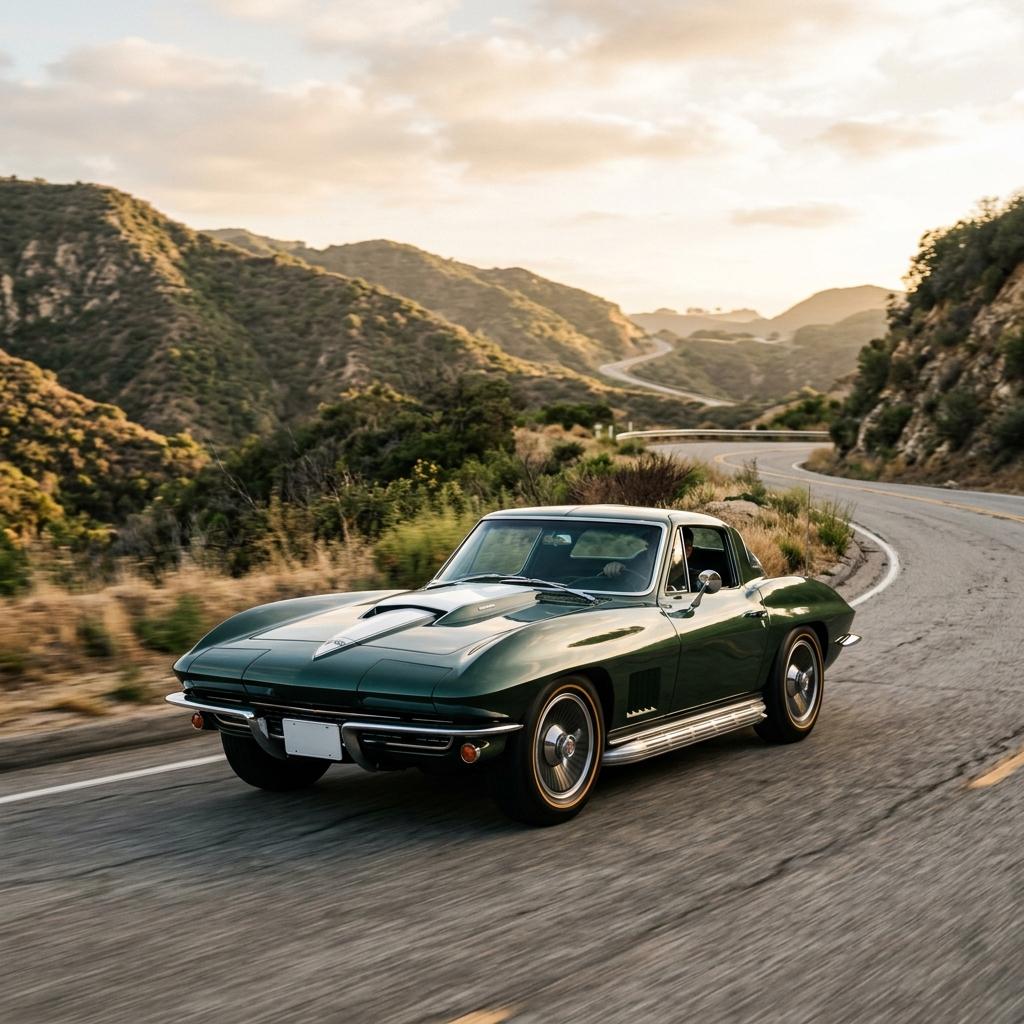
If the C1 saved the Corvette, the second-generation (C2) "Sting Ray," introduced in 1963, made it a legend. Designed by Larry Shinoda under the direction of Bill Mitchell, the C2 featured a stunning, aggressively creased body, hidden headlights, and the iconic (though short-lived) split rear window.
Underneath the fiberglass, the C2 was a massive leap forward. Duntov finally engineered an independent rear suspension, dramatically improving handling. It was also the era of the massive Big Block V8s, culminating in the fearsome L88 engine—a barely disguised race engine producing well over 500 horsepower that was secretly offered to the public.
The C3 and the Malaise Era
The third-generation (C3) Corvette, introduced in 1968, was heavily inspired by the "Mako Shark II" concept car. It featured wildly exaggerated curves and Coke-bottle styling. While the early C3s (often called "Chrome Bumpers") were incredibly powerful, the 1970s brought strict emissions regulations and the fuel crisis.
The Corvette suffered greatly during this "Malaise Era." By 1975, the base engine produced a dismal 165 horsepower. Despite the drastic drop in performance, the stunning C3 remained incredibly popular, proving that the Corvette's appeal was as much about its dramatic styling and image as it was about raw speed.
The Modern Era: C4 through C7
The Corvette slowly clawed its way back to performance relevance. The C4 (1984) introduced a highly advanced, stiff chassis and electronic fuel injection. The C5 (1997) was a monumental leap, featuring a rear-mounted transaxle for perfect 50/50 weight distribution and the debut of the legendary LS-series aluminum V8 engines.
The C6 (2005) introduced the 638-horsepower supercharged ZR1, known as the "Blue Devil," proving the Corvette could comfortably exceed 200 mph. The C7 (2014) sharpened the handling, introduced highly advanced electronic differentials, and featured an aggressive, sharp-edged design.
The C8: The Mid-Engine Masterpiece
For decades, Zora Arkus-Duntov argued that the traditional front-engine, rear-wheel-drive layout had reached its absolute physical limits regarding traction and handling. He dreamed of a mid-engine Corvette. In 2020, with the release of the C8, Chevrolet finally realized Duntov's vision.
Moving the engine behind the driver completely transformed the car. It provided the C8 with supercar proportions, massively improved forward visibility, and crucially, placed the weight directly over the rear drive wheels. The C8 Stingray can accelerate from 0-60 mph in under 3.0 seconds—a figure previously reserved for million-dollar hypercars. The new Z06 variant features a flat-plane crank V8 that screams to 8,600 rpm. The C8 represents the most radical evolution in the Corvette's history, securing its legacy as a true world-beater for the modern era.
Technical Specifications (C8 Corvette Stingray Z51)
- Engine: 6.2-liter (6,162 cc) LT2 V8, Naturally Aspirated
- Valvetrain: OHV, 2 valves per cylinder
- Power Output: 495 hp (369 kW) @ 6,450 rpm
- Torque: 470 lb-ft (637 Nm) @ 5,150 rpm
- Transmission: 8-speed Dual-Clutch Automatic
- Drivetrain: Mid-Engine, Rear-Wheel Drive
- Chassis: Aluminum spaceframe
- Weight: Approx. 1,655 kg (3,647 lbs)
- 0-60 mph (0-100 km/h): 2.9 seconds
- Top Speed: 194 mph (312 km/h)
Kenji Sato
Kenji Sato is a contributing writer for Primedealsearch, bringing refined insights and expertise to our readers.