Prancing Horse Legacy: The Ferrari F40
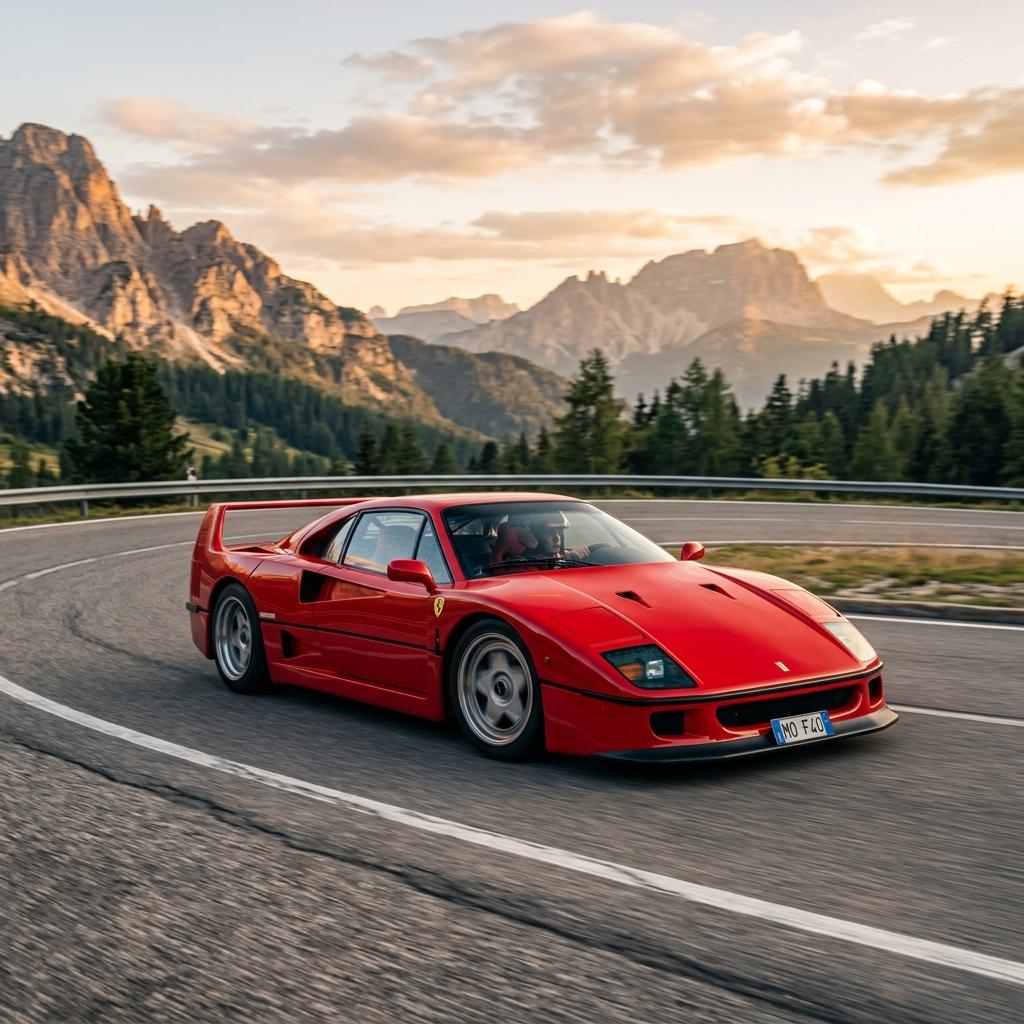
Enzo Ferrari's final masterpiece. A raw, twin-turbocharged V8 track weapon for the road.
The Ferrari F40 is more than just a supercar; it is a sacred object in the automotive world. Built to celebrate the company’s 40th anniversary in 1987, it was the very last car personally approved by Enzo Ferrari before his death. Uncompromising, brutal, and utterly thrilling, the F40 was conceived as a visceral reaction against the increasingly heavy and complex supercars of the era (specifically the Porsche 959). It was, in essence, a street-legal race car that defined a generation and remains, for many, the greatest driver's car ever created.
Enzo's Final Masterpiece
By the mid-1980s, Enzo Ferrari was growing concerned that his road cars were becoming too soft and luxurious. When Porsche introduced the highly advanced, all-wheel-drive 959, Ferrari felt the need to re-establish dominance. The directive to his engineering team was simple but daunting: build the fastest, most thrilling road car in the world, and strip away anything that doesn't make it go faster. The F40 was born from the aborted 288 GTO Evoluzione Group B racing project, inheriting its aggressive racing DNA.
A Chassis Born from Racing
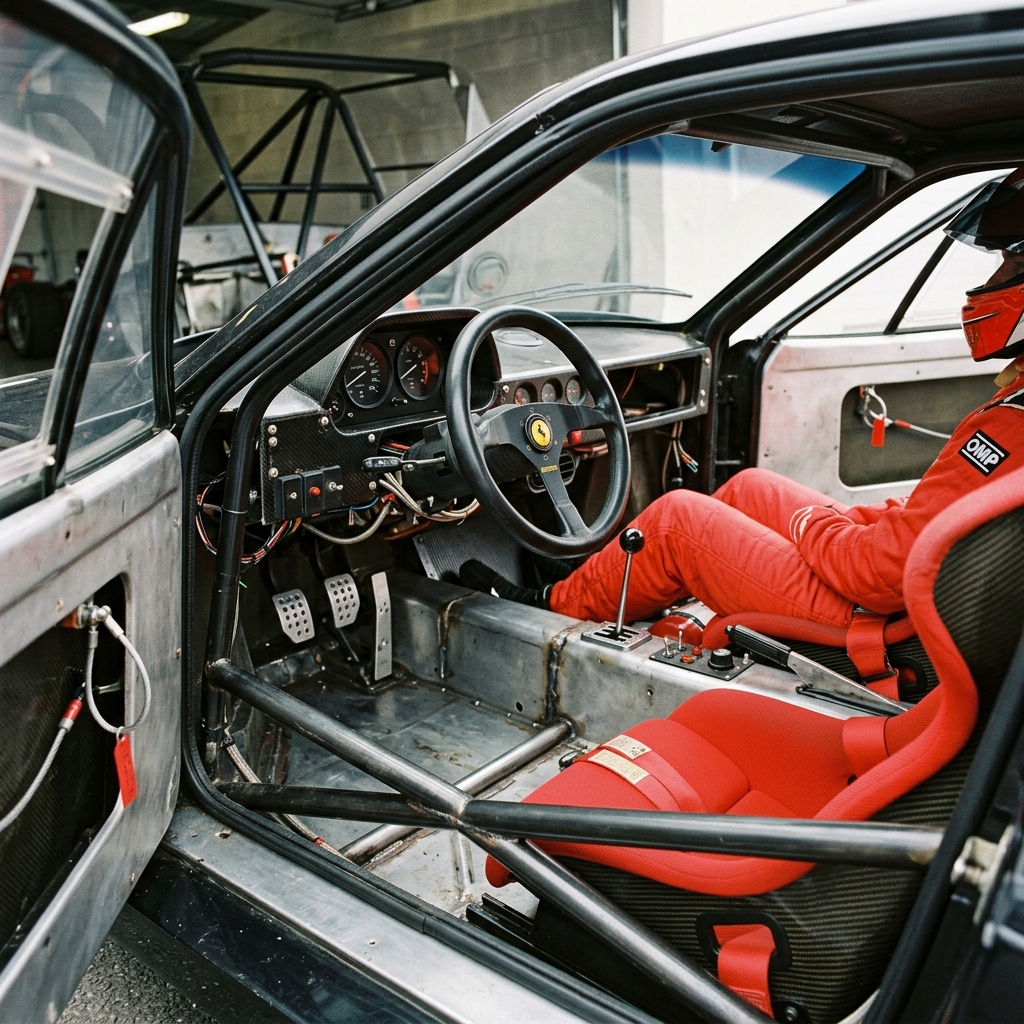
Beneath the iconic red bodywork, the F40 utilized a tubular steel spaceframe chassis. To increase rigidity and reduce weight, Ferrari bonded Kevlar panels to this steel frame—a technique borrowed directly from their Formula 1 program. This was the first time such advanced composite materials were used extensively in a production road car. The suspension was a pure racing setup: independent unequal-length wishbones with coil-over shock absorbers and anti-roll bars front and rear.
The 2.9-liter Twin-Turbo V8
The beating heart of the F40 was a 2.9-liter (2,936 cc) twin-turbocharged, 90-degree V8 engine (Tipo F120A). It was a development of the engine used in the 288 GTO. Equipped with dual IHI turbochargers operating at 1.1 bar (16 psi) of boost and twin Behr intercoolers, it produced a staggering 471 horsepower (478 PS) at 7,000 rpm and 426 lb-ft of torque at 4,000 rpm.
Because of the enormous turbo lag, driving the F40 required massive respect. Below 4,000 rpm, the engine felt relatively docile. But once the turbos spooled up, the power delivery was violently explosive, capable of overwhelming the massive 335-section rear tires in an instant.
Stripped Down: The Pursuit of Lightness
Weight reduction in the F40 bordered on the obsessive. The body panels were crafted entirely from Kevlar, carbon fiber, and aluminum. The paint applied at the factory was notoriously thin—so thin, in fact, that you could clearly see the weave of the carbon-Kevlar panels shining through the Rosso Corsa red paint.
Inside, the cabin was a masterclass in minimalism. There was no radio, no glove box, no leather upholstery, no carpets, and no door panels. To open the doors from the inside, you pulled a simple wire cable. The windows were lightweight plastic (Lexan), and early models even featured sliding windows rather than roll-down glass. As a result of this extreme diet, the F40 weighed an incredibly light 1,100 kg (2,425 lbs) dry.
Aerodynamics: Form Dictated by Speed
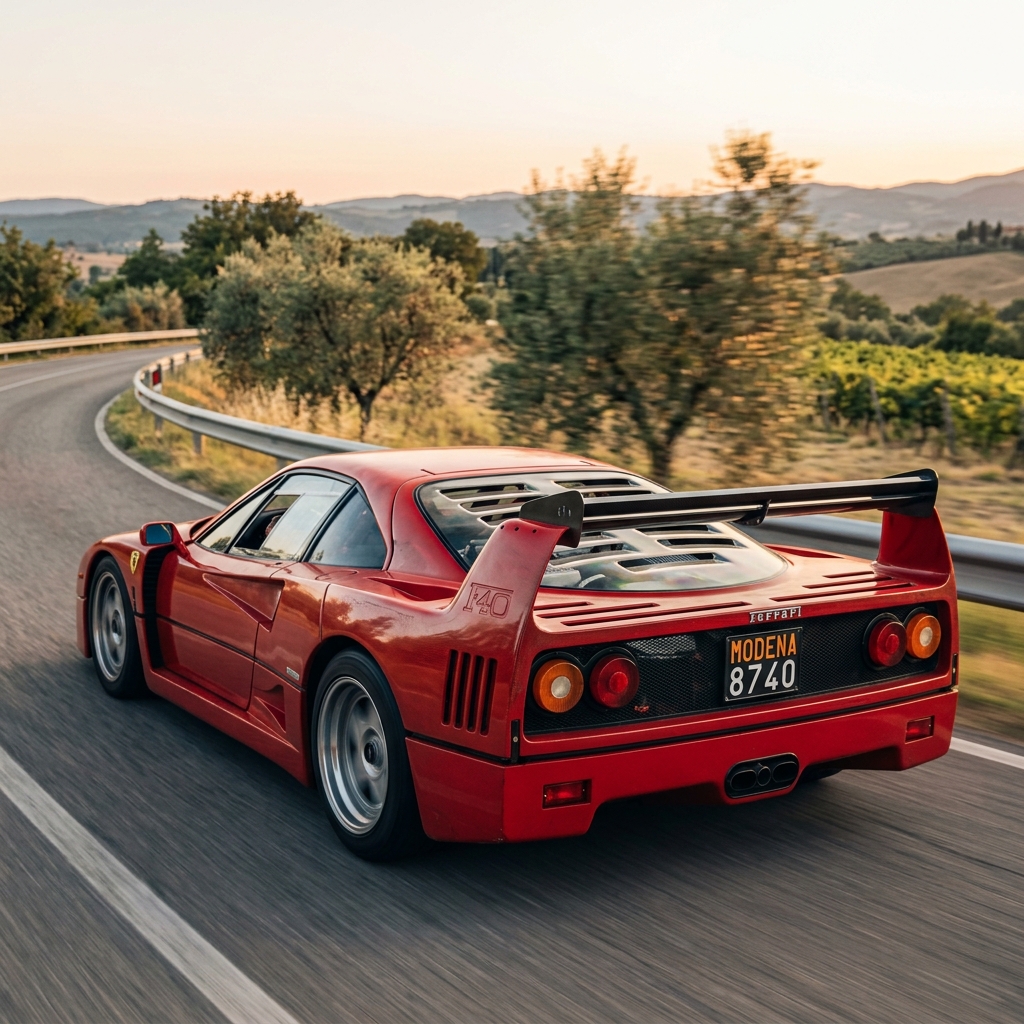
Designed by Leonardo Fioravanti at Pininfarina, the F40's shape was dictated entirely by aerodynamics. The massive, integrated rear wing wasn't just for show; it was essential for keeping the rear wheels planted at high speeds. The extensive use of NACA ducts provided necessary cooling for the massive brakes and the mid-mounted engine. The drag coefficient was a highly respectable 0.34, allowing the F40 to slice through the air efficiently.
The F40 holds a special place in history as the first production road car to officially break the 200 mph barrier, achieving a verified top speed of 201.4 mph (324 km/h), narrowly beating the Porsche 959.
The Driving Experience: Pure Terror and Joy
Driving an F40 is described by those lucky enough to experience it as a sensory overload. With no power steering and no power brakes (let alone ABS or traction control), the driver is entirely responsible for the car's behavior. The cabin is filled with the deafening sound of the V8 engine, the hissing of the turbo wastegates, and the clattering of stones hitting the uninsulated wheel arches. It is a car that demands total concentration and immense skill, rewarding the driver with an unfiltered, telepathic connection to the road.
The Legacy of the F40
Originally, Ferrari planned a production run of just 400 units. However, demand was so overwhelmingly high that they eventually built 1,315 examples. Today, the Ferrari F40 is universally recognized as the ultimate analog supercar. It represents the end of an era before electronics completely took over automotive engineering. It remains Enzo Ferrari's final, glorious gift to the automotive world.
Technical Specifications
- Engine: 2.9-liter (2,936 cc) Tipo F120A V8, Twin-Turbocharged
- Valvetrain: DOHC, 4 valves per cylinder
- Power Output: 471 hp (352 kW) @ 7,000 rpm
- Torque: 426 lb-ft (577 Nm) @ 4,000 rpm
- Transmission: 5-speed manual
- Drivetrain: Rear-Wheel Drive
- Chassis: Tubular steel spaceframe with Kevlar panels
- Weight: Approx. 1,100 kg (2,425 lbs) dry
- 0-60 mph (0-100 km/h): 4.1 seconds
- Top Speed: 201.4 mph (324 km/h)
Elena Shift
Elena Shift is a contributing writer for Primedealsearch, bringing refined insights and expertise to our readers.