The Golden Age of Group B Rally

Too fast to race. Remembering the most dangerous and thrilling era of the World Rally Championship.
Between 1982 and 1986, the World Rally Championship (WRC) experienced an era of unprecedented mechanical insanity, terrifying speeds, and unfettered engineering creativity. This was Group B. It is universally remembered as the "Golden Age" of rallying—a brief, shining, and ultimately tragic period where motorsport regulations were virtually non-existent, resulting in the creation of the most spectacular and dangerous racing cars ever to slide across gravel.
The Golden Age of Rallying
In 1982, the FIA (motorsport's governing body) introduced new regulations to encourage manufacturer participation. They replaced the restrictive Group 4 rules with "Group B." The genius (and ultimate flaw) of Group B was its incredibly loose homologation requirements.
To compete in Group 4, a manufacturer had to build 400 road-going versions of their rally car. For Group B, the requirement was slashed to just 200 cars. Furthermore, the rules placed almost no restrictions on turbocharger boost pressure, exotic materials (like Kevlar and magnesium), or aerodynamic appendages. This loophole allowed engineers to design bespoke, mid-engine, tube-frame, 500-horsepower racing prototypes masquerading as compact hatchbacks.
Audi Quattro vs. Lancia Rally 037
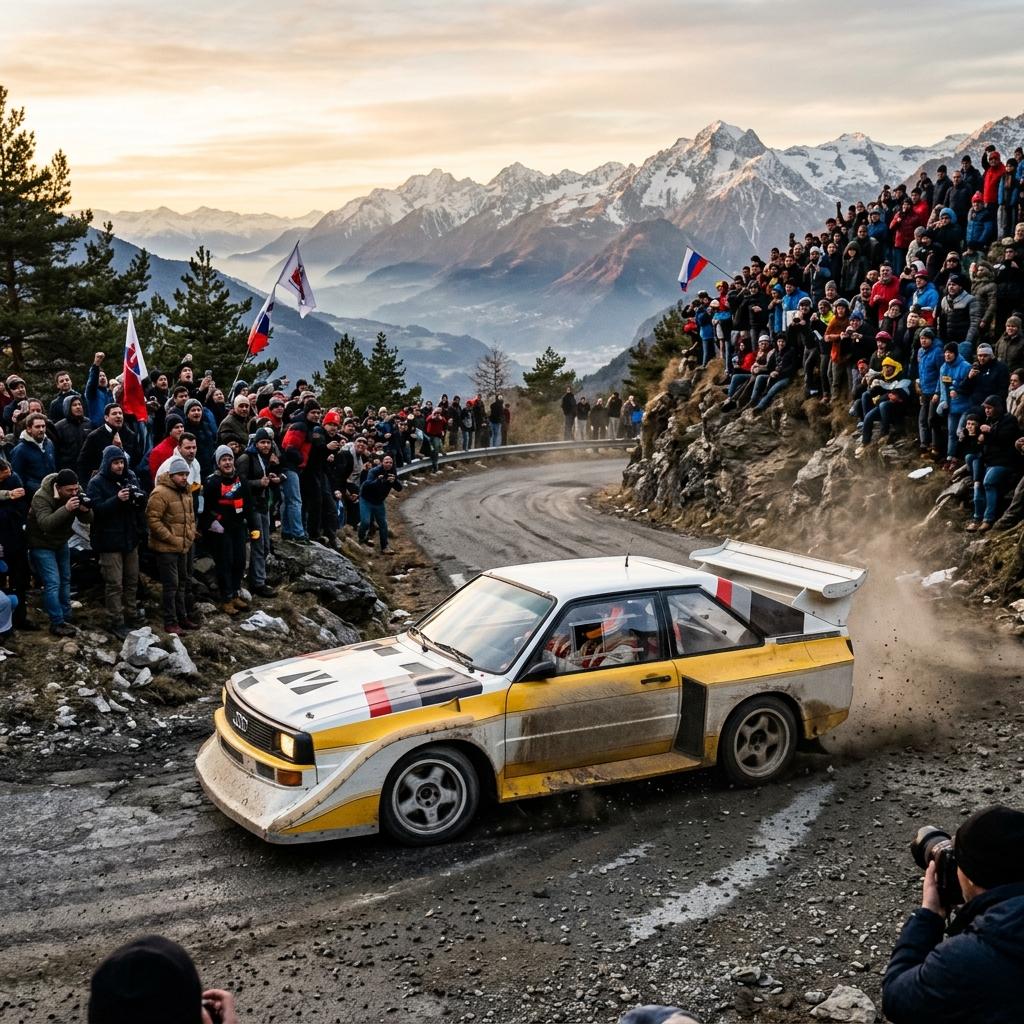
The era began with an epic battle of philosophies. Audi had recently revolutionized rallying with the "Quattro"—the first reliable, high-performance all-wheel-drive system. Powered by a heavy, front-mounted turbocharged five-cylinder engine, the Quattro possessed immense grip and devastated the competition on snow and gravel.
Lancia, however, believed that a lightweight, mid-engine, rear-wheel-drive car was the superior platform for tarmac and tight courses. They built the stunning Lancia Rally 037. In 1983, through brilliant driving by Walter Röhrl and Markku Alén, and some notoriously clever bending of the rules by team boss Cesare Fiorio, the rear-wheel-drive Lancia 037 miraculously defeated the all-wheel-drive Audi Quattro to win the Manufacturers' Championship. It remains the last 2WD car ever to win the WRC.
The Monsters Evolve: Peugeot 205 T16 and Lancia Delta S4
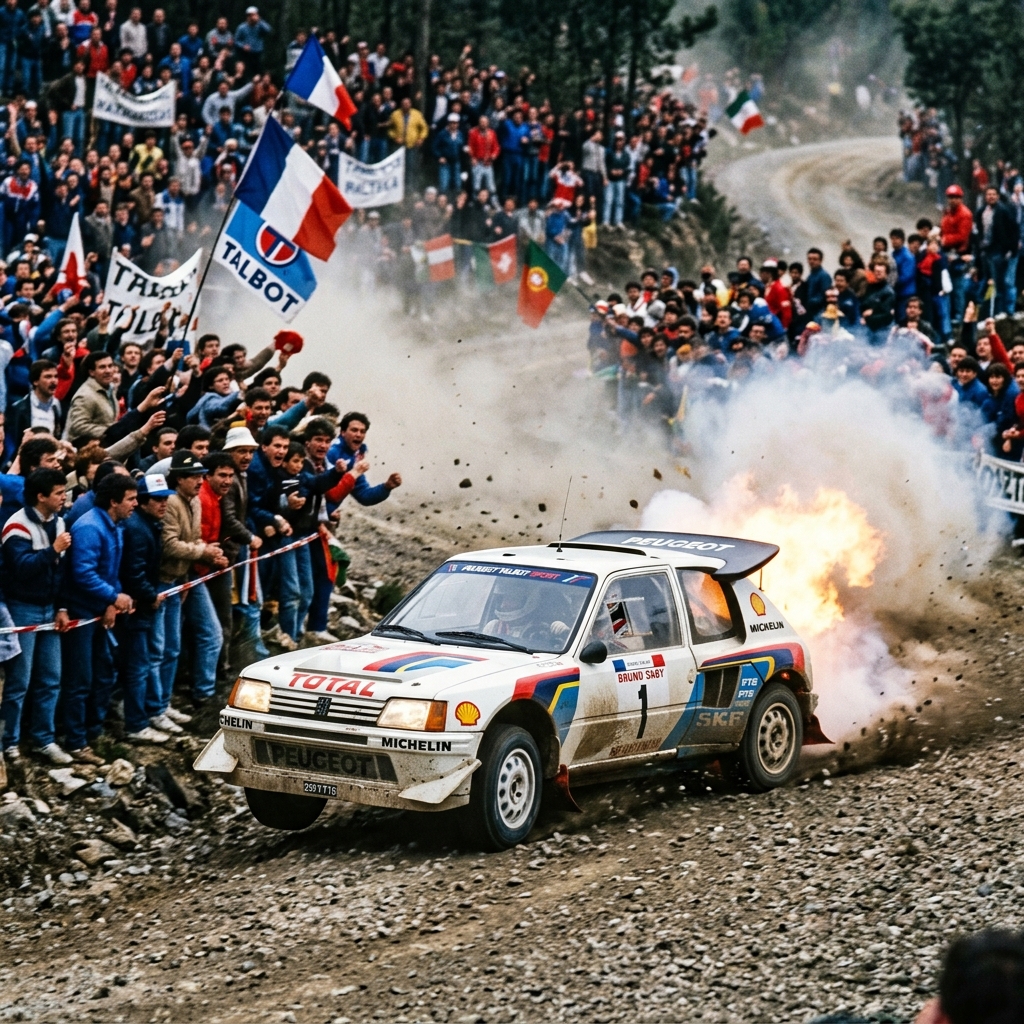
By 1984, the writing was on the wall: to win Group B, a car needed a mid-mounted engine for balance and all-wheel drive for traction. Peugeot entered the fray with the 205 T16. Visually resembling a humble shopping hatchback, the T16 was a tube-frame monster with a mid-mounted turbocharged engine and advanced AWD. It was highly agile and incredibly successful, winning the championship in '85 and '86.
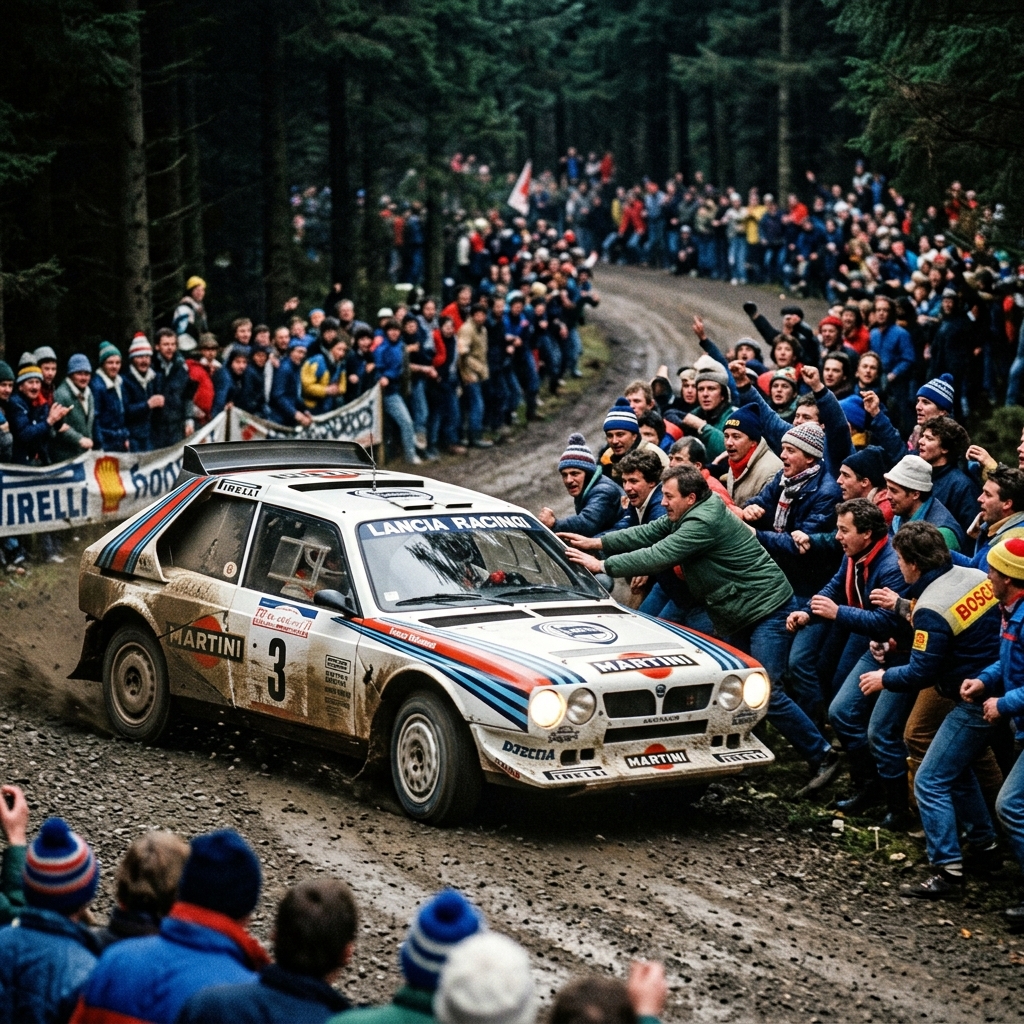
Lancia responded with the ultimate Group B weapon: the Delta S4. To combat the turbo lag that plagued early Group B cars, Lancia engineered a "Twincharged" system. The 1.8-liter engine featured both a supercharger (for instant low-end grunt) and an enormous turbocharger (for massive high-end power). The S4 could reportedly accelerate from 0 to 60 mph on gravel in under 2.5 seconds. The cars were producing well over 500 horsepower, and speeds were reaching Formula 1 levels on narrow, tree-lined dirt roads.
The Danger Escalates: Fans and Fire
As the cars became exponentially faster, the environment they raced in remained dangerously unchanged. Rallying inherently takes place on public roads, through forests, and along mountain cliffs.
The biggest issue was the fans. Thrilled by the flames, noise, and sheer violence of the Group B monsters, spectators flocked to the stages in the hundreds of thousands. With virtually no crowd control, fans stood on the very edge of the road, parting like the Red Sea only inches before a 500-horsepower car slid past at 100 mph. Drivers spoke of finding severed fingers in the grills of their cars at the end of a stage. The cars themselves, built from highly flammable Kevlar and carrying massive fuel tanks, became magnesium-fueled firebombs in the event of a crash.
The Tragic End: Corsica 1986
The sheer speed and lack of safety finally caught up with Group B. In 1986, at the Rally of Portugal, a Ford RS200 plunged into a wall of spectators, killing three and injuring dozens. The factory teams immediately withdrew from the event.
The fatal blow occurred just weeks later at the Tour de Corse. Henri Toivonen, the brilliant and fearless driver of the Lancia Delta S4, and his co-driver Sergio Cresto, plunged off a mountain ravine. The car’s lightweight Kevlar fuel tank ruptured, and the ensuing magnesium fire incinerated the car instantly, leaving only the charred tubular frame. Both men perished.
Within hours, the FIA recognized that the cars had simply become too fast for human reflexes to safely control on public roads. Group B was immediately banned for the following 1987 season, replaced by the significantly slower, production-based Group A regulations.
The Myth and the Legacy
Group B lasted only four years, but its impact is eternal. It represents a time when engineers were unchained, and drivers possessed a superhuman level of bravery. Today, surviving Group B cars are immensely valuable collector's items. The era is looked back upon with a mixture of profound awe for the incredible machines it produced, and somber respect for the lives it claimed. It was rallying's brightest, most beautiful, and most terrifying flame.
Key Group B Cars
- Audi Sport Quattro S1 E2: The ultimate iteration of the AWD pioneer, featuring massive aerodynamic wings and a shrieking 5-cylinder engine.
- Lancia Rally 037: The beautiful, supercharged, RWD masterpiece that defied the AWD revolution for one glorious year.
- Peugeot 205 Turbo 16: The perfectly balanced, mid-engine AWD hatch that ultimately mastered the formula.
- Lancia Delta S4: The terrifyingly fast, twin-charged apex predator that pushed the limits too far.
- Ford RS200: A purpose-built, highly advanced platform that arrived too late to realize its full potential.
Alex Driver
Alex Driver is a contributing writer for Primedealsearch, bringing refined insights and expertise to our readers.