Honda Civic Type R: Engineering the Perfect Hot Hatch

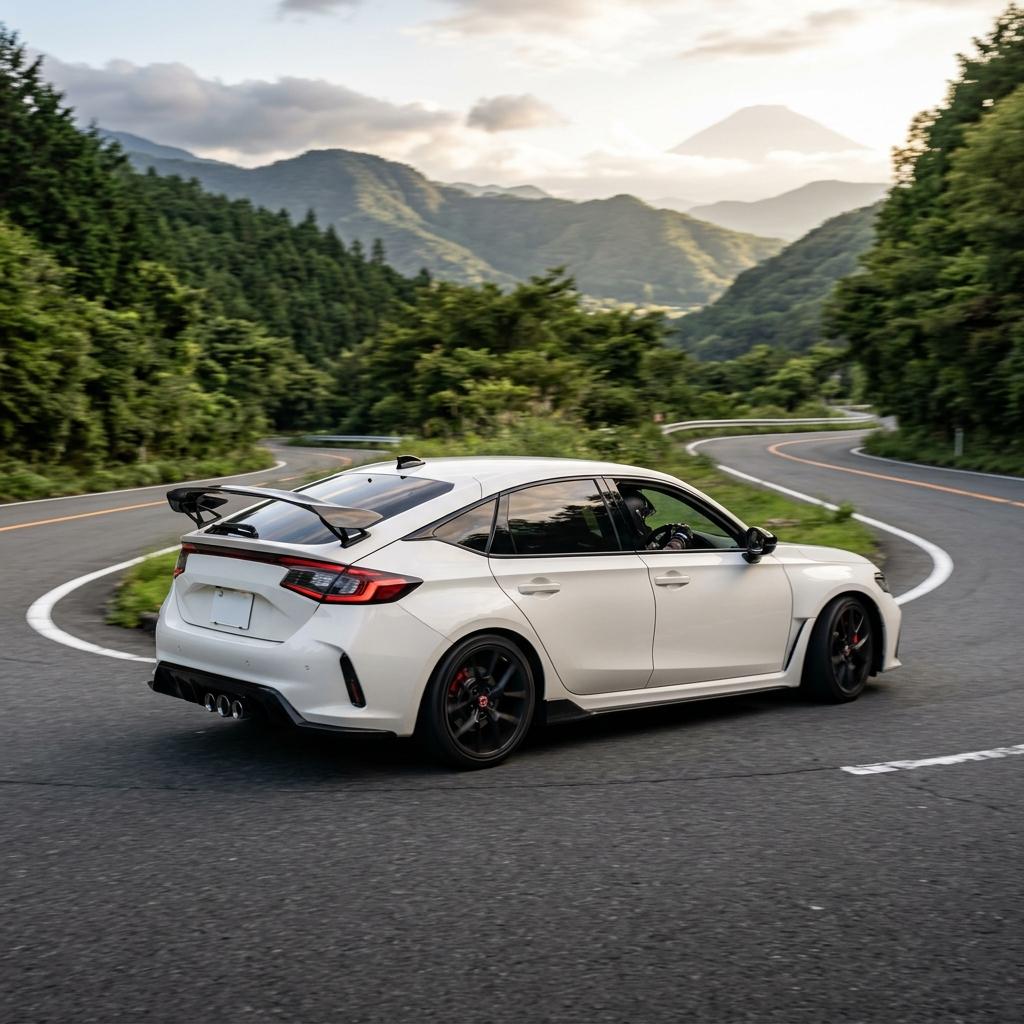
From the EP3 to the FL5, Honda's engineers have obsessed over every gram, every degree of camber, and every decibel.
In the hierarchy of performance cars, front-wheel drive (FWD) was long considered the inferior layout, relegated to economical hatchbacks and deemed incapable of handling serious horsepower due to chronic understeer and torque steer. Honda, a company built on a stubborn refusal to accept engineering limitations, spent nearly three decades proving the critics wrong. Through the evolution of the Civic Type R, Honda didn't just build a fast economy car; they engineered the absolute pinnacle of front-wheel-drive performance, consistently humbling significantly more expensive rear-wheel and all-wheel-drive sports cars on racetracks worldwide.
The Red Badge Heritage
The "Type R" (Racing) designation is sacred within Honda. It is reserved only for vehicles engineered to represent the ultimate expression of the company's motorsport heritage. Cars bearing the red "H" badge undergo rigorous weight reduction, engine tuning, and chassis stiffening.
The lineage began in 1997 with the legendary EK9 Civic Type R in Japan. It was characterized by a high-revving, naturally aspirated B16B engine that produced an incredible 115 horsepower per liter without a turbocharger. It established the Type R formula: lightweight, manic high-RPM naturally aspirated power, and razor-sharp, lift-off oversteer handling.
The Evolution of the Front-Wheel Drive Hot Hatch
For years, Honda stuck faithfully to naturally aspirated engines (through the EP3 and FD2/FN2 generations). However, as European rivals like the Volkswagen Golf R and Ford Focus RS moved to turbocharged engines and all-wheel drive, Honda was forced to adapt to the horsepower wars.
In 2015, the FK2 Civic Type R debuted, fundamentally altering the recipe. It introduced the K20C1 2.0-liter turbocharged engine producing over 300 horsepower. Putting that much power through the front wheels usually results in catastrophic torque steer (where the steering wheel violently rips to one side under hard acceleration). Honda needed a mechanical solution.
The Dual-Axis Strut Suspension
The key to taming 300+ horsepower in a FWD car is Honda’s "Dual-Axis" MacPherson strut front suspension. In a standard MacPherson strut, the steering axis is the strut itself. When power is applied, the unequal angles of the driveshafts cause torque steer.
Honda’s Dual-Axis system separates the steering knuckle from the suspension strut. This drastically reduces the steering axis inclination and the scrub radius. In simpler terms, it mechanically isolates the steering from the engine's torque. Combined with a mechanical Helical Limited-Slip Differential (LSD) that physically locks the front wheels together for maximum traction, the Civic Type R can deploy massive power out of a corner without ripping the steering wheel from the driver’s hands.
The FK8: Aggressive Design and Turbo Power
The 2017 FK8 generation was the first Civic Type R officially sold in the United States. It was visually polarizing, covered in aggressive wings, vortex generators, and fake vents. However, the design was highly functional, making it one of the few cars in its class to generate genuine aerodynamic downforce at speed.
The FK8 was a revelation to drive. It shattered the Nürburgring Nordschleife lap record for front-wheel-drive cars (7:43.8). Despite the aggressive looks, it possessed a brilliant adaptive damper system that made it remarkably comfortable for daily driving, perfectly executing the dual-nature requirement of a hot hatch.
The FL5: Refining the Formula
In 2022, Honda introduced the latest generation, the FL5 Civic Type R. They addressed the primary criticism of the FK8 by significantly toning down the exterior styling, resulting in a wider, sleeker, and more mature aesthetic.
Under the skin, the K20C1 engine was refined to produce 315 horsepower, making it the most powerful Honda ever sold in the US. The chassis was stiffened further, and the cooling systems were upgraded. The FL5 immediately reclaimed the Nürburgring FWD record with a staggering time of 7:44.881 (on the slightly longer official 20.8km track layout).
The Honda Civic Type R stands as an engineering triumph. It proves that with brilliant suspension geometry and obsessive tuning, the front-wheel-drive platform is not a compromise, but a highly capable, immensely rewarding architecture capable of achieving genuine sports car greatness.
Technical Specifications (2023 FL5 Civic Type R)
- Engine: 2.0-liter (1,996 cc) K20C1 Inline-4, Turbocharged
- Valvetrain: DOHC, 4 valves per cylinder with VTEC
- Power Output: 315 hp (235 kW) @ 6,500 rpm
- Torque: 310 lb-ft (420 Nm) @ 2,600 - 4,000 rpm
- Transmission: 6-speed manual with rev-matching
- Drivetrain: Front-Wheel Drive with Helical Limited-Slip Differential
- Suspension: Dual-Axis MacPherson strut front, Multi-link rear (Adaptive Dampers)
- Weight: Approx. 1,446 kg (3,188 lbs)
- 0-60 mph (0-100 km/h): 4.9 seconds
- Top Speed: 170 mph (274 km/h)
Alex Driver
Alex Driver is a contributing writer for Primedealsearch, bringing refined insights and expertise to our readers.