Godzilla Returns: Why the Nissan Skyline GT-R is the King of JDM

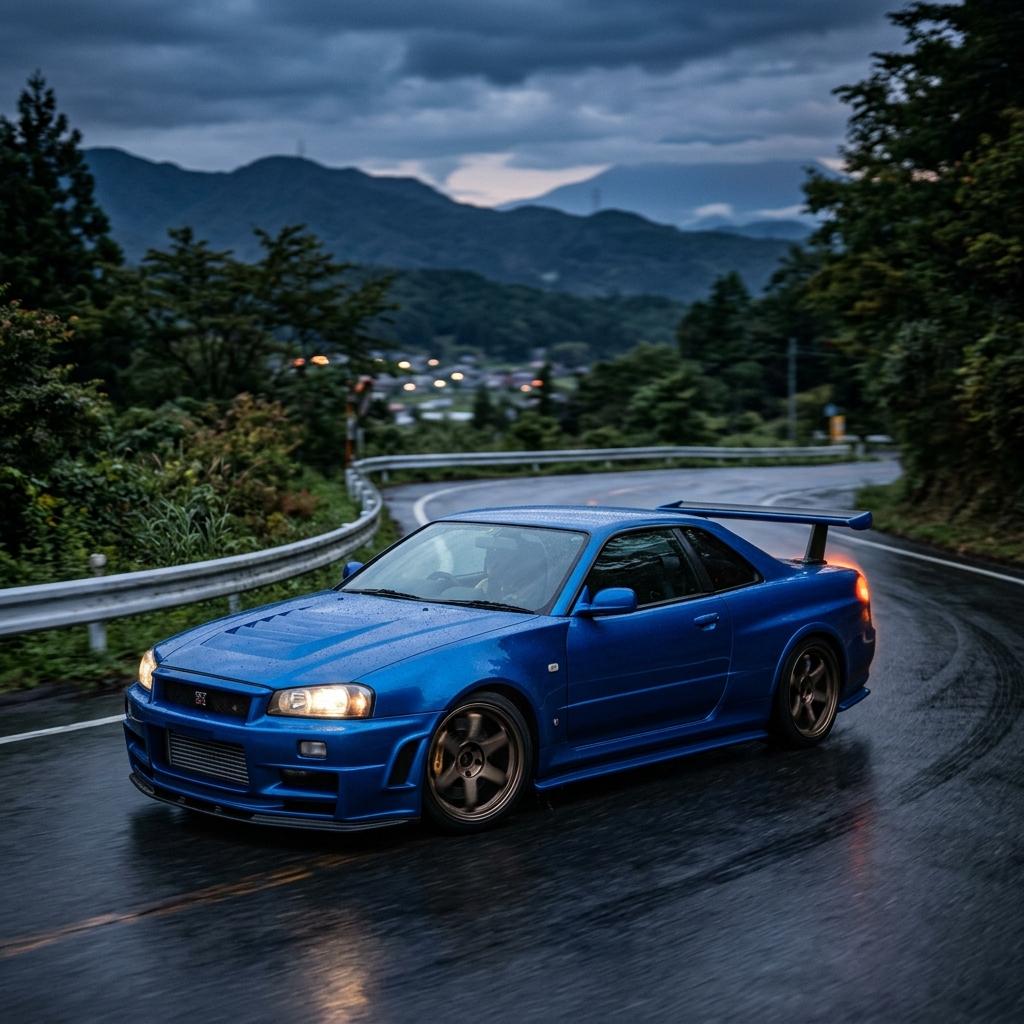
The ATTESA E-TS all-wheel drive and RB26DETT engine defined the rules of the game worldwide.
No car embodies the spirit of Japanese performance engineering quite like the Nissan Skyline GT-R. Nicknamed 'Godzilla' by the Australian motoring press after it completely annihilated the competition in their domestic touring car championships, the GT-R represented a quantum leap in performance technology when it arrived in 1989. Over three distinct generations in the 1990s and early 2000s, the GT-R evolved from a homologation special into a global automotive icon, proving that raw power combined with sophisticated electronics could conquer the world.
The Birth of Godzilla
The "GT-R" badge actually dates back to 1969 with the "Hakosuka" (boxy Skyline) and the 1973 "Kenmeri" models, both of which enjoyed immense success in domestic Japanese racing. However, the oil crisis of the 1970s effectively killed high-performance vehicle development, putting the GT-R badge to sleep for sixteen years.
It wasn't until 1989, amidst Japan's booming "bubble economy," that Nissan resurrected the legend. The objective was straightforward but monumentally ambitious: to build a car capable of dominating Group A racing worldwide, specifically targeting the previously unbeatable Ford Sierra RS500 Cosworth. The result was the R32 Skyline GT-R.
The R32: Dominance Through Technology
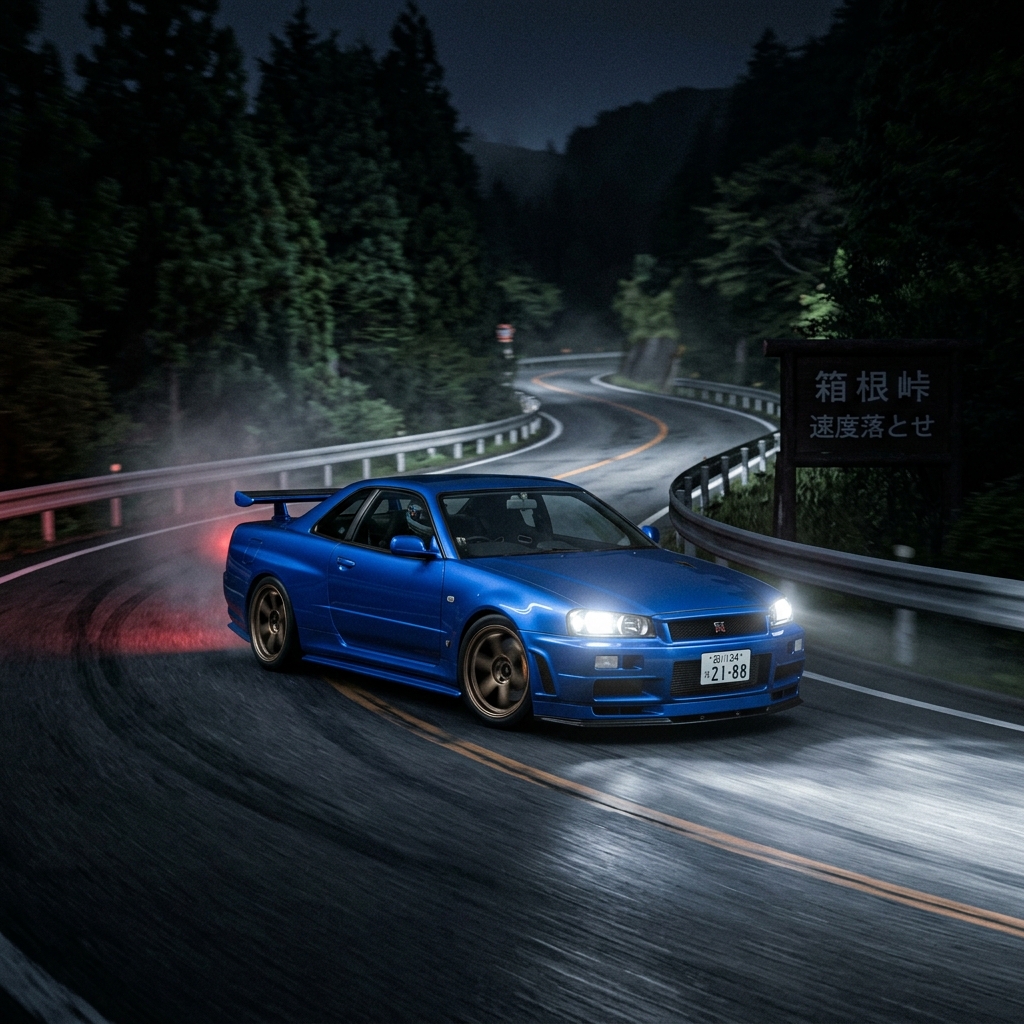
When the R32 GT-R debuted, it rewrote the rulebook for performance cars. Instead of relying solely on massive displacement or lightweight construction, Nissan engineers leveraged cutting-edge technology. The car was heavy by the standards of the day, weighing in at over 1,430 kg (3,150 lbs), but it carried an arsenal of electronic aids that made it faster and more capable than anything else on the road or track.
In racing trim, the R32 GT-R was so overwhelmingly dominant that it practically destroyed the Group A racing category. In the Japanese Touring Car Championship (JTCC), the R32 won all 29 races it entered over four seasons. In Australia, its sheer pace forced the governing body to ban turbocharged all-wheel-drive cars entirely, changing the rules to favor domestic V8s. It was this absolute domination that earned it the moniker "Godzilla" – the monster from Japan that destroyed everything in its path.
The Heart of the Beast: The RB26DETT Engine
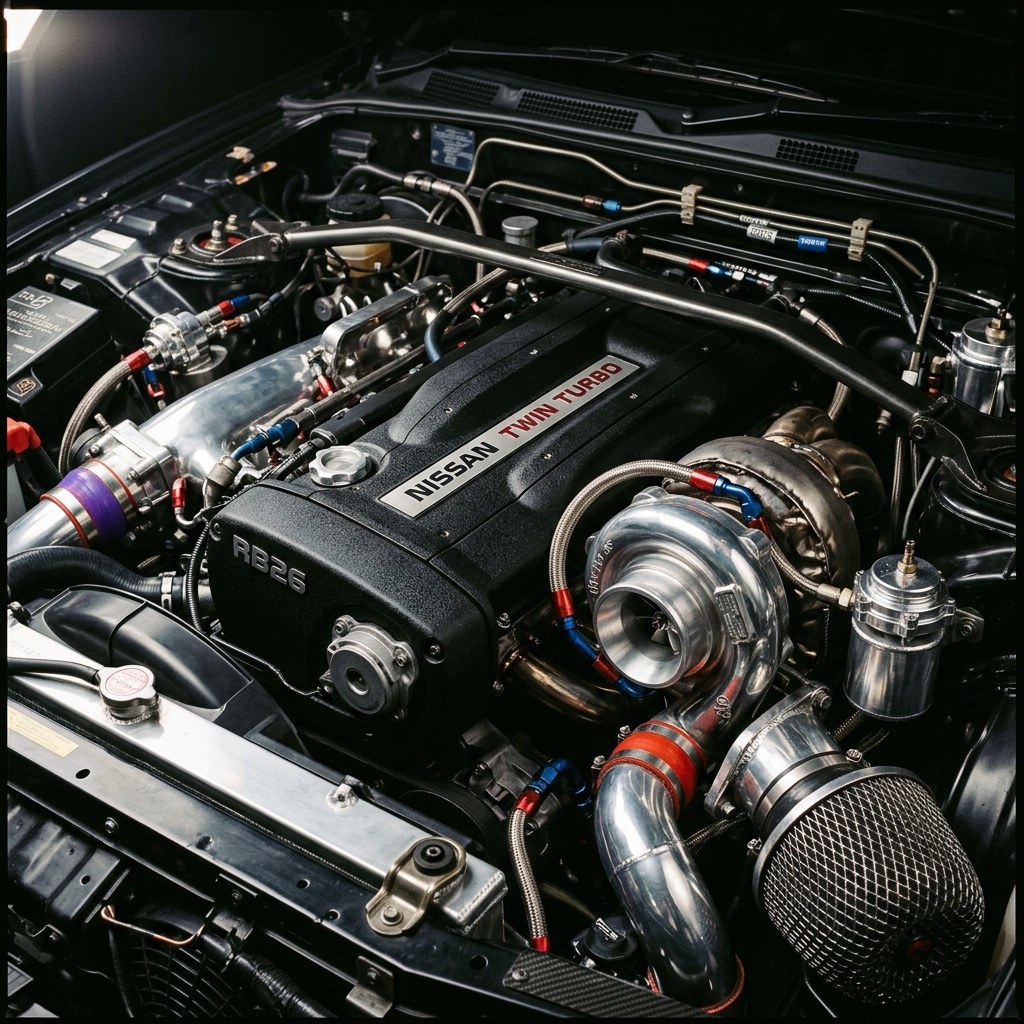
At the core of the GT-R's mythos is the legendary RB26DETT engine. This 2.6-liter, inline-six cylinder, twin-turbocharged masterpiece is considered one of the greatest engines ever produced. Designed with Group A racing regulations in mind, the 2.6-liter displacement was perfectly calculated to fit into the 4,000cc equivalent class when factoring in the turbo multiplier.
Officially, due to a "gentleman's agreement" among Japanese automakers aimed at curbing highway racing, the engine was advertised as producing 276 horsepower (280 PS). In reality, standard cars rolled off the showroom floor producing closer to 320 horsepower. More importantly, the RB26 was immensely overbuilt. Featuring a robust cast-iron block, individual throttle bodies, and high-capacity parallel turbochargers, the engine could reliably produce upwards of 600 horsepower with basic modifications, and over 1,000 horsepower with extensive tuning.
The ATTESA E-TS All-Wheel Drive System
Power is nothing without control, and the GT-R's secret weapon was the Advanced Total Traction Engineering System for All-Terrain Electronic Torque Split (ATTESA E-TS). Unlike traditional, permanent all-wheel-drive systems that induced heavy understeer, Nissan’s system was rear-wheel-drive biased.
Under normal driving conditions, 100% of the engine's power was sent to the rear wheels, giving the GT-R the nimble, communicative feel of a traditional sports car. However, an array of sensors monitored wheel slip, lateral G-forces, and throttle position. The moment the rear wheels began to lose traction, a hydraulically actuated multi-plate clutch could instantly route up to 50% of the power to the front wheels. This allowed drivers to confidently deploy massive amounts of power mid-corner, launching the car out of bends with terrifying efficiency. Combined with the Super HICAS four-wheel steering system, the GT-R cornered like a vehicle half its weight.
Evolution of the Species: The R33 and R34
Following the success of the R32, Nissan introduced the R33 GT-R in 1995. The R33 was slightly larger, wider, and heavier, shifting the character of the car more towards a high-speed grand tourer. However, aerodynamic improvements, an active limited-slip rear differential (in V-Spec models), and a stiffer chassis made it inherently faster. It famously became the first production car to lap the Nürburgring Nordschleife in under 8 minutes.
In 1999, Nissan unleashed the ultimate iteration of the Skyline GT-R: the R34. Visually aggressive, aerodynamically sophisticated, and technologically advanced, the R34 was a masterpiece. The chassis was significantly stiffened, turbo lag was reduced, and the ATTESA system was further refined. The interior featured a prominent Multi-Function Display (MFD) that provided real-time telemetry, including boost pressure, oil temperature, and G-forces—a feature heavily inspired by video games and highly unusual for the era.
Pop Culture Icon and Global Phenomenon
The Skyline GT-R's status was cemented not just on the race track, but through global pop culture. Since the car was never officially sold new in North America, it developed an intense aura of forbidden fruit. Its prominent feature in the Gran Turismo video game franchise allowed an entire generation of enthusiasts worldwide to experience its capabilities virtually. Later, starring roles in the Fast and Furious film franchise, driven by the late Paul Walker, elevated the R34 GT-R to legendary status alongside classic American muscle and European exotics.
The R35 and the Enduring Legacy
Production of the R34 Skyline GT-R ended in 2002. When Nissan finally revived the badge in 2007 with the R35, they dropped the "Skyline" name entirely. The R35 GT-R moved to a V6 engine and a rear-mounted transaxle, but it retained the core philosophy: devastating acceleration, sophisticated all-wheel drive, and the ability to humble supercars costing three times as much.
Today, pristine examples of the R32, R33, and especially the R34 GT-R command astronomical prices, regularly changing hands for hundreds of thousands of dollars. The Nissan Skyline GT-R remains the undisputed king of JDM (Japanese Domestic Market) performance—a technological marvel that defined a generation and proved that Japanese engineering could conquer the globe.
Technical Specifications (R34 V-Spec II)
- Engine: 2.6-liter (2,568 cc) RB26DETT Inline-6, Twin-Turbocharged
- Valvetrain: DOHC, 4 valves per cylinder
- Power Output: Advertised 276 hp (280 PS); Actual ~330 hp @ 6,800 rpm
- Torque: 289 lb-ft (392 Nm) @ 4,400 rpm
- Transmission: 6-speed Getrag manual
- Drivetrain: ATTESA E-TS Pro All-Wheel Drive with Active Rear LSD
- Chassis: Steel unibody
- Suspension: Multi-link front and rear
- Weight: Approx. 1,560 kg (3,439 lbs)
- 0-60 mph (0-100 km/h): ~4.8 seconds
- Top Speed: Approx. 155 mph (250 km/h) electronically limited
Elena Shift
Elena Shift is a contributing writer for Primedealsearch, bringing refined insights and expertise to our readers.