VTEC Kicked In: The Honda NSX Changing the Supercar Game

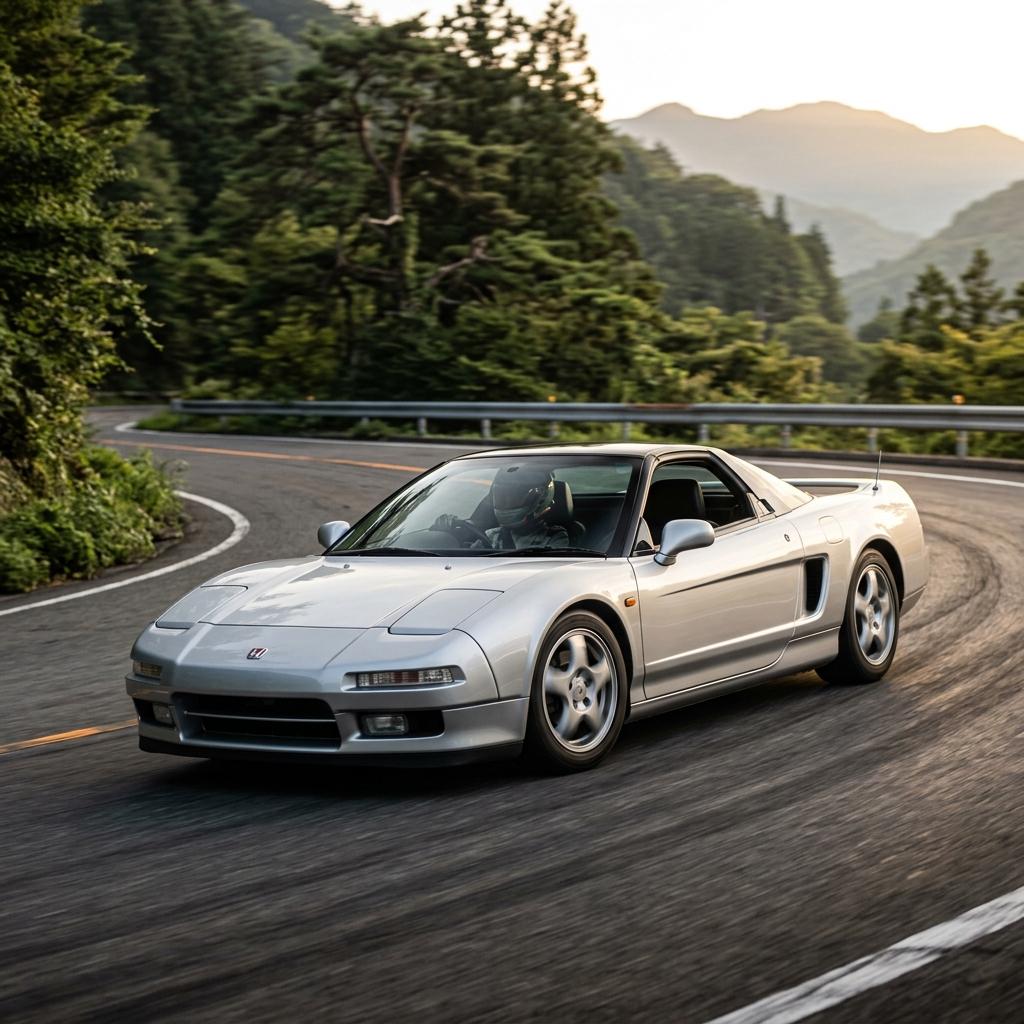
Developed with Ayrton Senna, the original NSX proved that supercars could be reliable and everyday usable.
In the late 1980s, the supercar landscape was dominated by European aristocracy: Ferrari, Porsche, and Lamborghini. These cars were incredibly fast and beautiful, but they were also notoriously temperamental, ergonomically flawed, punishing to drive, and demanded exorbitant maintenance. Honda, a company built on brilliant, reliable engineering and fresh off dominating Formula 1, decided to challenge this establishment. Their weapon was the NSX (New Sportscar eXperimental), a car that didn't just compete with the Europeans; it fundamentally rewrote the rulebook for what a supercar could and should be.
Challenging the European Aristocracy
Honda's brief was ambitious: build a mid-engine supercar capable of matching or beating the performance of the Ferrari 328 (and later the 348), but infuse it with the reliability, daily usability, and ergonomics of a Honda Civic.
To achieve this, Honda poured immense resources into the project, utilizing their vast Formula 1 engineering experience. The design team, led by Ken Okuyama and Shigeru Uehara, focused not on raw, brute force, but on lightweight construction, aerodynamic efficiency, and sublime chassis dynamics.
Ayrton Senna's Crucial Input
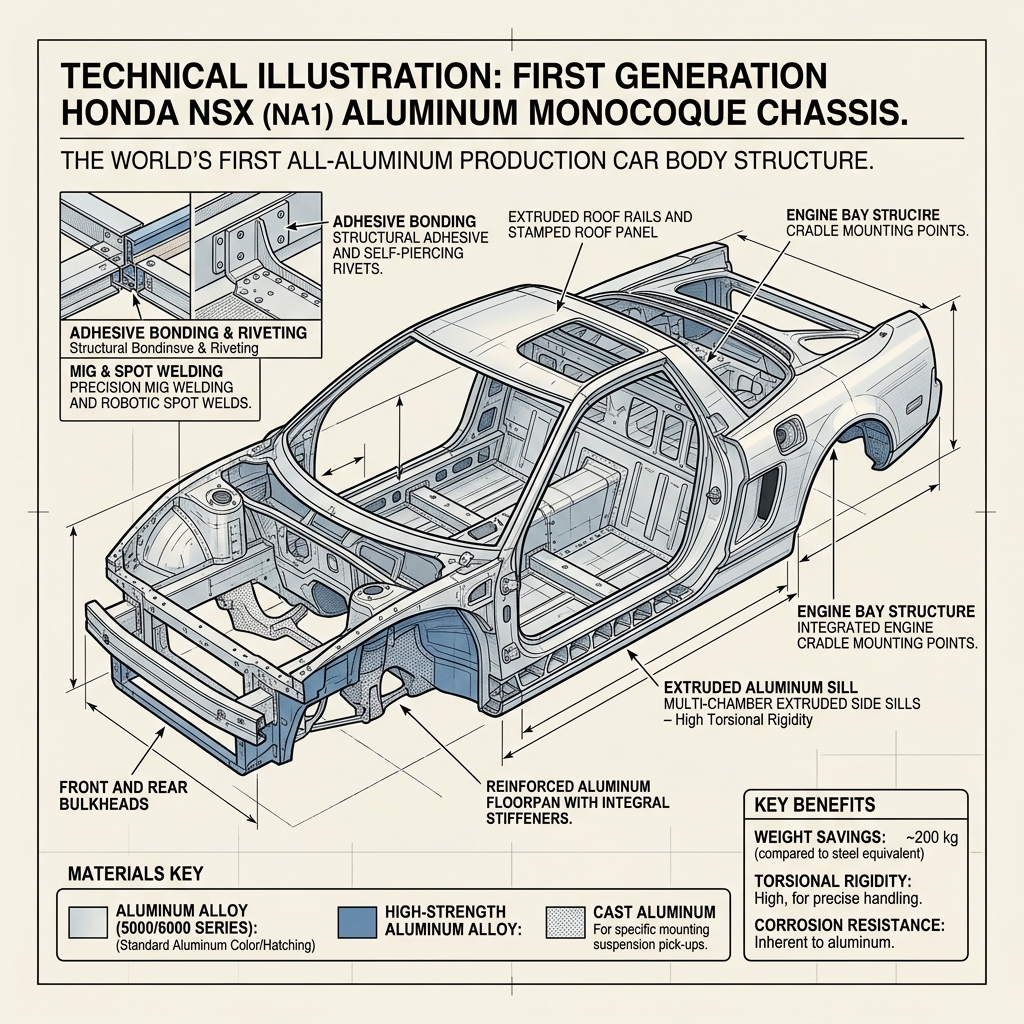
While Honda engineers created a brilliant baseline, the car's legendary handling characteristics were refined by motorsport royalty. The great Ayrton Senna, driving for McLaren-Honda in F1 at the time, test-drove an early prototype of the NSX at the Suzuka Circuit.
Senna famously provided blunt feedback, telling the engineers that the chassis felt "fragile" and lacked rigidity. Honda took his words to heart, returning to the drawing board and stiffening the chassis by a massive 50%. Senna continued to test the car at the Nürburgring, helping fine-tune the suspension geometry. His input was instrumental in transforming the NSX from a fast car into an incredibly precise, communicative driving instrument.
The All-Aluminum Monocoque Chassis
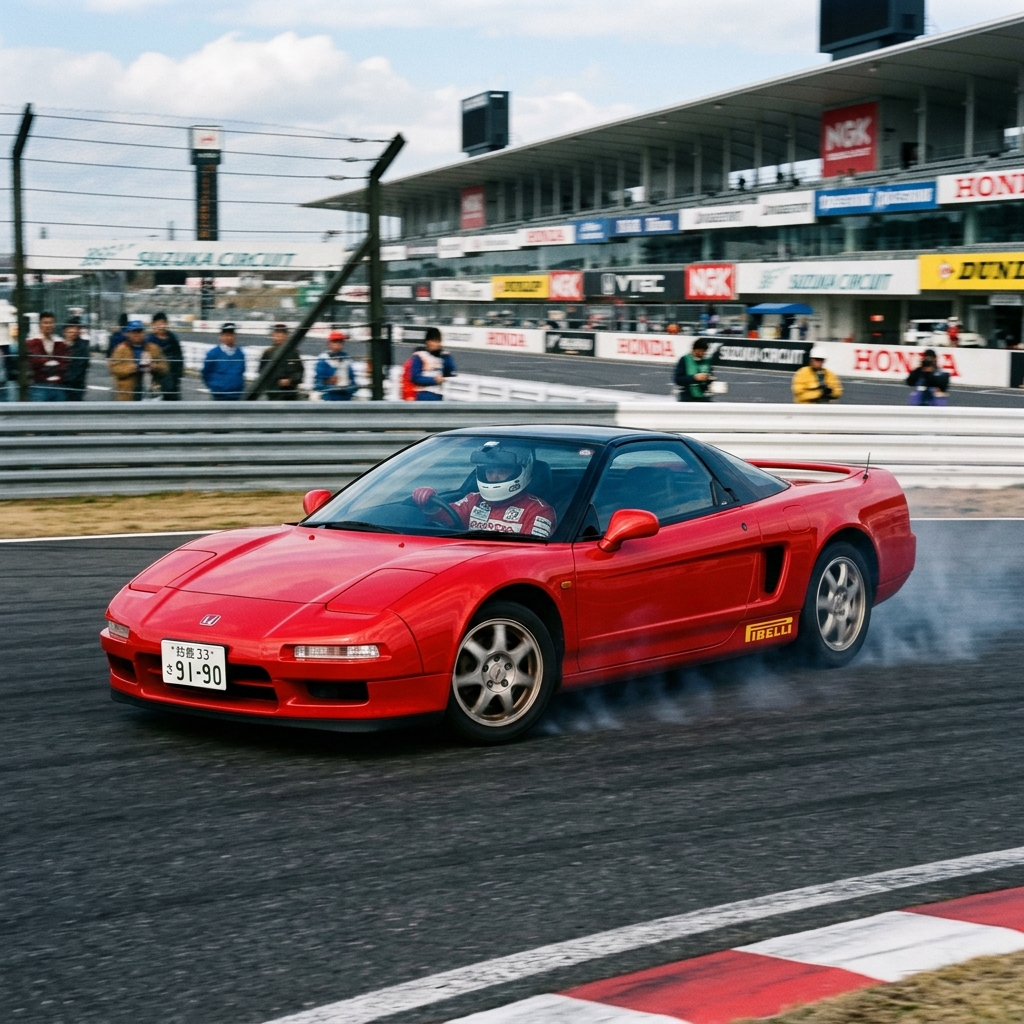
To combat weight and improve rigidity, Honda pioneered a revolutionary manufacturing process: the NSX featured the world’s first mass-produced all-aluminum monocoque chassis and body.
Using aluminum saved roughly 200 kilograms (440 lbs) compared to a traditional steel chassis, while providing greater structural stiffness. This lightweight philosophy paid massive dividends in handling agility, acceleration, and braking, allowing the NSX to do more with less horsepower than its European rivals.
The Heart of the NSX: VTEC Technology
Powering the NSX was a beautifully crafted 3.0-liter (later 3.2-liter) naturally aspirated V6 engine (the C30A). Producing 270 horsepower, it wasn't the most powerful engine in the segment, but it possessed a technological ace up its sleeve: VTEC (Variable Valve Timing and Lift Electronic Control).
VTEC allowed the engine to operate with two distinct camshaft profiles. Below 5,800 RPM, it ran on a mild cam profile, providing smooth idling, excellent fuel economy, and strong low-end torque for daily driving. But when the tachometer crossed 5,800 RPM, the system hydraulically locked a third rocker arm onto a high-lift, long-duration cam profile. The engine’s character instantly transformed, shrieking toward an 8,000 RPM redline with the ferocity of a race car. It was a Jekyll-and-Hyde engine that provided the best of both worlds.
Ergonomics: A Supercar You Could See Out Of
Perhaps the most shocking aspect of the NSX was its interior. Inspired by the 360-degree visibility of the F-16 fighter jet canopy, the NSX's cabin featured a low cowl and vast expanses of glass. Unlike a Lamborghini Countach, where the driver was cramped and blind, an NSX driver enjoyed excellent outward visibility, comfortable seating, highly effective air conditioning, and a premium audio system.
The controls were perfectly placed, the clutch was light, and the gear shift was rifle-bolt precise. It was a supercar that was genuinely easy to drive in stop-and-go traffic, yet thrilling on a canyon road.
Reliability: Redefining Exotic Car Ownership
Before the NSX, owning a supercar meant accepting constant mechanical headaches. The NSX shattered this paradigm. It was a Honda. Owners could put 100,000 miles on an NSX with little more than routine maintenance. It didn't leak oil, the electronics worked flawlessly, and it started every time you turned the key.
This reliability forced the European manufacturers to adapt. Following the release of the NSX, Ferrari had to drastically improve the build quality, ergonomics, and reliability of the F355 and 360 Modena. The NSX effectively killed the idea that a supercar had to be punishing to be authentic.
The Legacy of the First-Gen NSX
The original NSX remained in production for 15 years (1990-2005), seeing subtle revisions, the introduction of a targa roof (NSX-T), a larger 3.2L engine, and the aggressive, lightweight NSX-R variants.
Today, the first-generation Honda (and Acura) NSX is revered as a masterpiece of analog automotive engineering. It proves that a supercar doesn't need a massive V12 or thousands of horsepower to be legendary; it just requires perfect balance, obsessive engineering, and a focus on the pure joy of driving.
Technical Specifications (1991 NSX 3.0L)
- Engine: 3.0-liter (2,977 cc) V6, Naturally Aspirated
- Valvetrain: DOHC, 4 valves per cylinder with VTEC
- Power Output: 270 hp (201 kW) @ 7,100 rpm
- Torque: 210 lb-ft (285 Nm) @ 5,300 rpm
- Transmission: 5-speed manual
- Drivetrain: Rear-Wheel Drive with Limited-Slip Differential
- Chassis: All-aluminum monocoque
- Suspension: Independent double-wishbone front and rear
- Weight: Approx. 1,370 kg (3,020 lbs)
- 0-60 mph (0-100 km/h): 5.7 seconds
- Top Speed: 168 mph (270 km/h)
Marcus Gear
Marcus Gear is a contributing writer for Primedealsearch, bringing refined insights and expertise to our readers.