Drift King: The Toyota AE86 Story

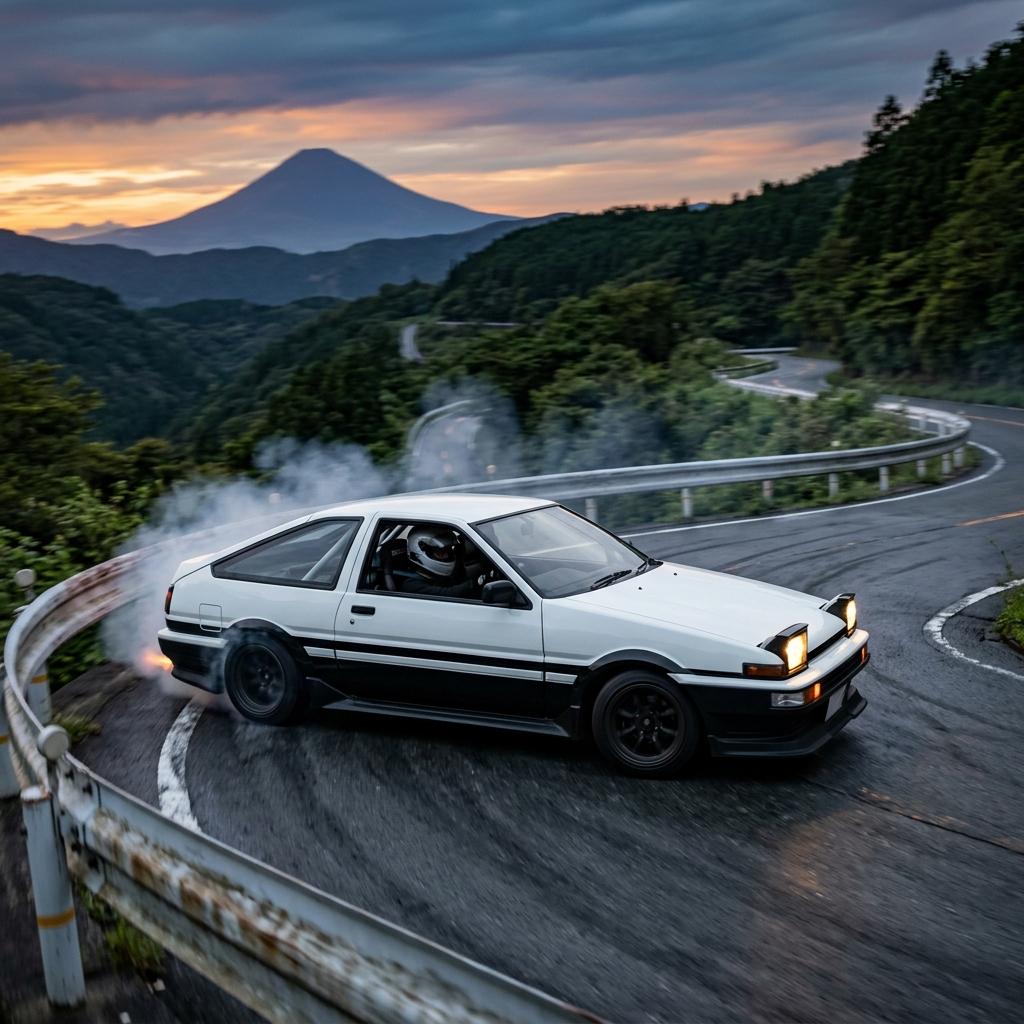
How a humble, lightweight Corolla became the ultimate icon of mountain pass drifting.
In the pantheon of legendary sports cars, there are million-dollar Ferraris, record-breaking Bugattis, and twin-turbocharged Nissan Skylines. But sitting alongside them is an unassuming, boxy, low-horsepower Toyota hatchback from the 1980s. The Toyota AE86—known globally as the Corolla GT-S and in Japan simply as the "Hachi-Roku" (Eight-Six)—is an automotive anomaly. It did not conquer Le Mans, nor did it break speed records. Instead, it became a cultural icon, giving birth to the sport of drifting and proving that immense horsepower is entirely secondary to perfect chassis balance.
The Legend of the Hachi-Roku
Introduced in 1983 as part of the fifth-generation Corolla lineup, the AE86 was actually an anachronism. While the rest of the Corolla range transitioned to modern, space-saving front-wheel-drive platforms, Toyota decided to keep one specific chassis configuration—the AE86 coupe and hatchback—on an older rear-wheel-drive platform.
They did this to appeal to driving enthusiasts and to maintain a competitive platform for Group A touring car racing and rallying. Available in two distinct front-end styles—the Trueno (with retractable pop-up headlights) and the Levin (with fixed rectangular headlights)—the AE86 was lightweight, affordable, and incredibly fun.
The 4A-GE Engine: A High-Revving Jewel
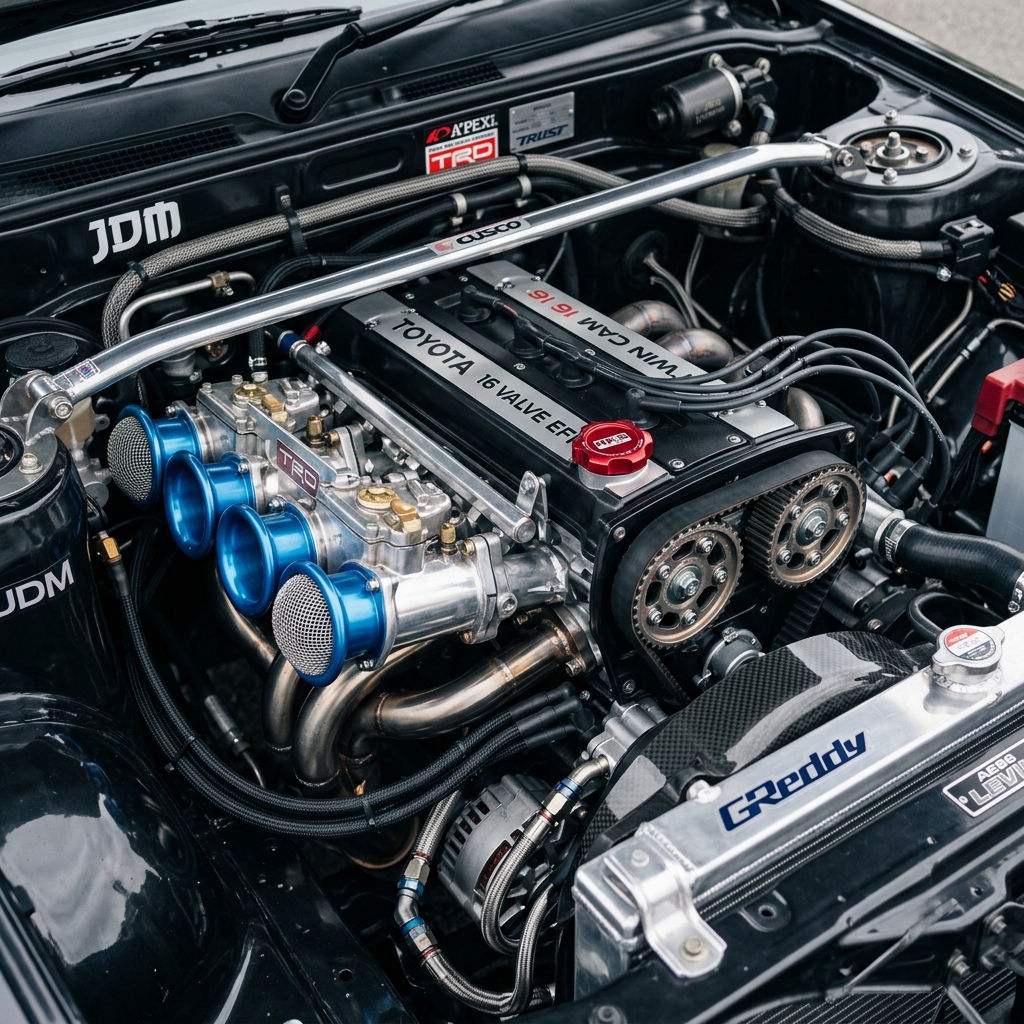
The heart of the AE86's appeal lies under its hood. It was powered by the legendary 4A-GE engine. This 1.6-liter, naturally aspirated inline-four cylinder engine was developed in collaboration with Yamaha. It featured dual overhead camshafts (DOHC) and four valves per cylinder, which was highly advanced technology for an affordable economy car in 1983.
Equipped with T-VIS (Toyota Variable Induction System) to improve low-end torque, the engine produced roughly 112 to 128 horsepower (depending on the market and emissions standards). While this doesn't sound like much, the magic of the 4A-GE was its character. It loved to be thrashed, happily screaming past a 7,500 rpm redline. It was a reliable, rev-happy jewel that perfectly matched the car's lightweight ethos.
Lightweight Rear-Wheel-Drive Perfection
The genius of the AE86 was its simplicity and balance. Weighing under 1,000 kg (roughly 2,200 lbs), the car had almost no mass to resist changes in direction. It featured MacPherson struts in the front and a four-link live axle in the rear. While a live rear axle is generally considered primitive compared to independent setups, Toyota tuned it brilliantly.
Combined with an optional factory Limited-Slip Differential (LSD), the rear-wheel-drive layout allowed drivers to easily break traction and steer the car with the throttle. It was an incredibly communicative chassis; it telegraphed exactly what it was doing to the driver, making it the perfect platform for learning car control at the absolute limit.
Keiichi Tsuchiya and the Birth of Drifting
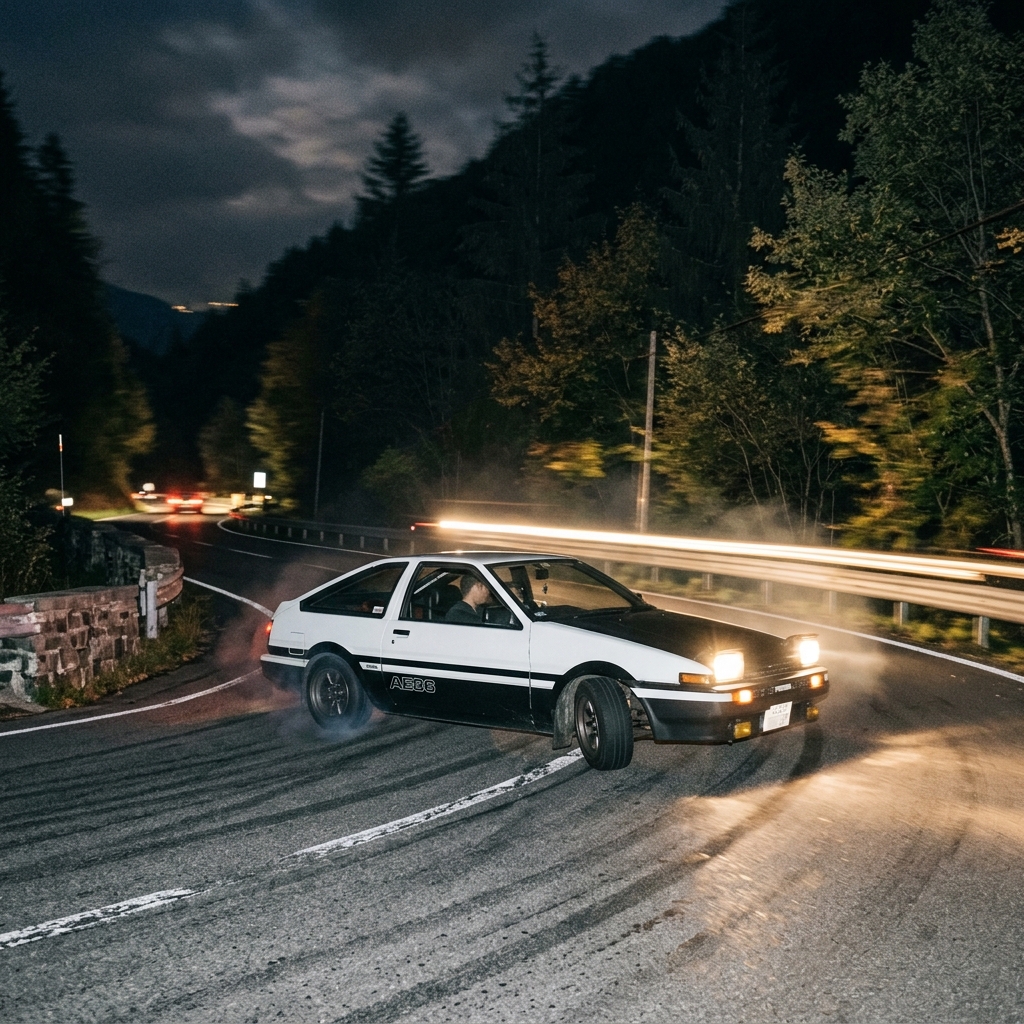
The AE86's legacy is inextricably linked to one man: Keiichi Tsuchiya, the "Drift King" (Dorikin). In the late 1980s, Tsuchiya was a professional racer who honed his skills by driving an AE86 aggressively on the treacherous, twisting mountain passes (touge) of Japan.
To maintain momentum through tight corners with only 120 horsepower, Tsuchiya perfected the art of throwing the AE86 sideways, sliding through corners on the very edge of control. A video titled Pluspy (1987) captured Tsuchiya aggressively drifting his AE86 on public roads. The video became an underground sensation, popularizing drifting as a driving style and eventually elevating it into a recognized global motorsport. The AE86 was the foundation upon which drifting was built.
Initial D: A Pop Culture Phenomenon
If Keiichi Tsuchiya made the AE86 famous in the racing world, a manga artist named Shuichi Shigeno made it a global pop culture icon. In 1995, Shigeno released Initial D, a manga (and later an incredibly popular anime) centered around illegal Japanese street racing.
The protagonist, Takumi Fujiwara, is a seemingly aloof teenager who delivers tofu in his father’s "panda" (black and white) Toyota Sprinter Trueno AE86. Using his intimate knowledge of the local mountain pass and the AE86's perfect balance, Takumi consistently defeats significantly more powerful, modern sports cars like the Nissan GT-R and Mazda RX-7. Initial D romanticized the underdog nature of the AE86, introducing the car to a massive new generation of enthusiasts worldwide and causing resale values of the 1980s hatchback to skyrocket.
The Tuner's Canvas
The AE86 remains one of the most modified cars in history. Because it is essentially an analog, mechanical Lego set, tuners have spent decades perfecting the formula. Common modifications include swapping the original engine for later 20-valve versions of the 4A-GE ("Silver Top" or "Black Top"), installing aggressive individual throttle bodies (ITBs), stripping the interior for weight reduction, and heavily upgrading the suspension geometry for competitive drifting.
The AE86 Legacy
In 2012, Toyota acknowledged the massive cultural impact of the AE86 by releasing its spiritual successor, the Toyota 86 (Subaru BRZ). Like the original, the modern 86 prioritizes lightweight, rear-wheel-drive dynamics and affordable fun over raw horsepower.
The original Toyota AE86 endures as a masterpiece of driving purity. It proves that the essence of a great sports car isn't found in a spec sheet or a top speed record; it is found in the joy, the communication, and the smile it puts on the driver's face when carving through a mountain road.
Technical Specifications (1985 Corolla GT-S)
- Engine: 1.6-liter (1,587 cc) 4A-GE Inline-4, Naturally Aspirated
- Valvetrain: DOHC, 4 valves per cylinder with T-VIS
- Power Output: 112 hp (84 kW) @ 6,600 rpm (US Spec)
- Torque: 97 lb-ft (132 Nm) @ 4,800 rpm
- Transmission: T50 5-speed manual
- Drivetrain: Rear-Wheel Drive with optional Limited-Slip Differential
- Chassis: Steel unibody
- Suspension: MacPherson strut front, 4-link live axle rear
- Weight: Approx. 960 kg (2,116 lbs)
- 0-60 mph (0-100 km/h): ~8.5 seconds
- Top Speed: 120 mph (193 km/h)
Alex Driver
Alex Driver is a contributing writer for Primedealsearch, bringing refined insights and expertise to our readers.