Land Rover Defender: The Unbreakable Legend

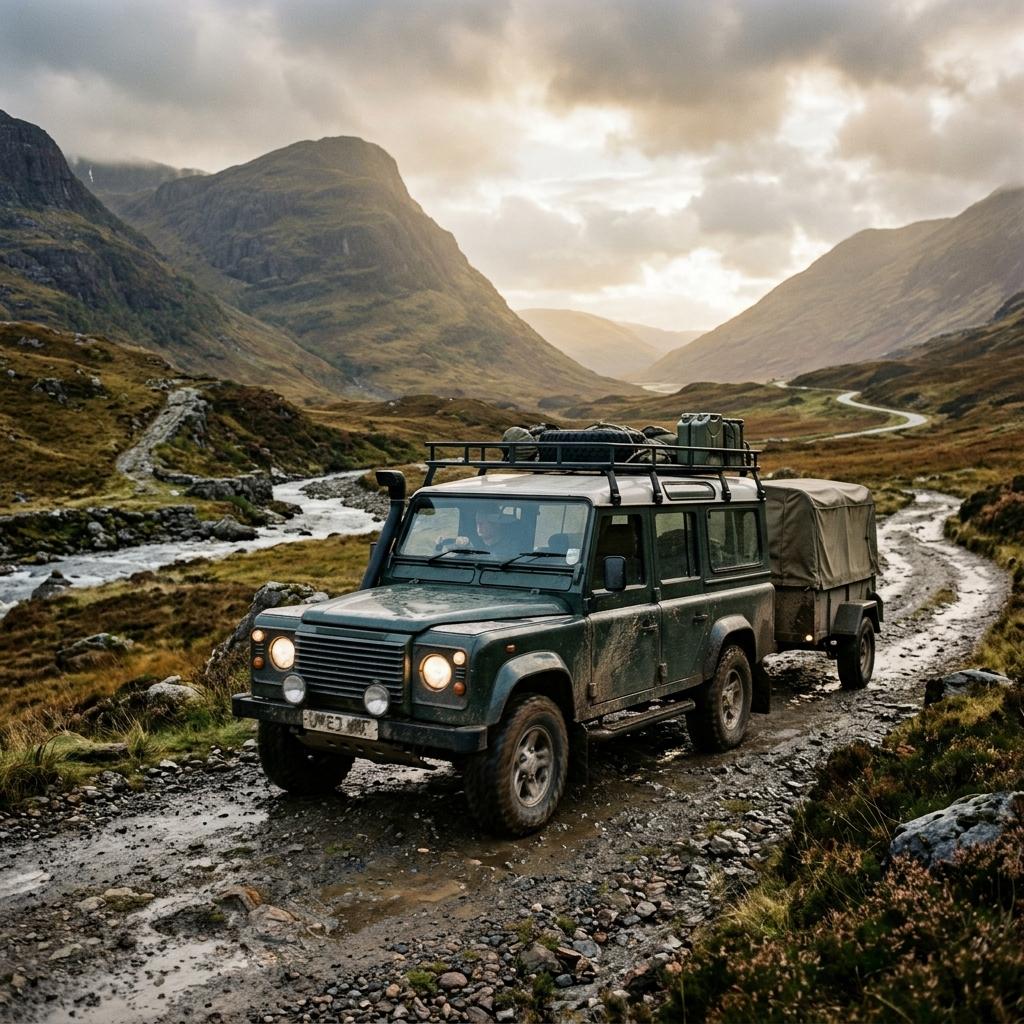
For 68 years, the Defender conquered terrain no other vehicle could manage. Then came its modern reinvention.
If the Willys Jeep won World War II, the Land Rover rebuilt the world afterward. Born in 1948 out of post-war austerity and a desperate need for agricultural machinery, the Land Rover (later named the Defender) became a global icon. From the muddy fields of the British countryside to the deepest, most treacherous jungles of Africa and South America, the Defender earned a reputation as the most capable, rugged, and unbreakable four-wheel-drive vehicle ever produced. It wasn't designed to be luxurious or fast; it was designed to survive.
The Series I Origins
Following WWII, the Rover Company was struggling. They built luxury cars, but the post-war British economy was crippled, and steel was heavily rationed. However, aluminum—leftover from aircraft production—was plentiful.
Maurice Wilks, Rover's chief designer, was using an ex-military US Jeep on his farm in Anglesey, Wales. Recognizing its utility, he proposed a British equivalent: a light agricultural vehicle capable of doing the work of a tractor. Using a Jeep chassis and Rover engine components, he built a prototype with a central steering wheel. The production "Series I" Land Rover debuted at the 1948 Amsterdam Motor Show. It was incredibly spartan, painted in light green (surplus military aircraft paint), and featured permanent four-wheel drive and a power take-off (PTO) to run farm equipment.
Form Dictated by Function
The design of the classic Land Rover (which evolved through Series I, II, III, and eventually became the Defender in 1990) was entirely dictated by function. It featured a boxy shape to maximize interior volume. The windshield was perfectly flat so that if it broke in the jungle, it could easily be replaced by a simple piece of flat glass cut to size.
The panels were completely flat, avoiding complex curves, which made manufacturing cheap and allowed owners to easily beat out dents in the field. The vehicle was characterized by its exposed door hinges, prominent rivets, and a spare tire mounted on the hood or the rear door.
The Aluminum Body
The defining engineering characteristic of the Defender is its construction: an incredibly robust, heavy-duty steel ladder-frame chassis topped with a body made almost entirely of a lightweight aluminum-magnesium alloy called Birmabright.
This construction choice, initially born from steel shortages, proved to be a masterstroke. The aluminum body was highly resistant to corrosion, meaning a Defender could wade through salty rivers or sit in humid jungles for decades without the body panels rusting away. This longevity is the primary reason why it is estimated that over 70% of all Land Rovers ever built are still in existence today.
Unstoppable Capability
What made the Defender legendary was its off-road prowess. It featured massive ground clearance, exceptionally short front and rear overhangs (allowing it to climb steep banks without scraping the bumpers), and a highly articulated solid axle suspension system with long-travel coil springs (introduced in 1983).
Equipped with a robust two-speed transfer case providing low-range gearing, a lockable center differential, and torquey, reliable diesel engines (most notably the 200Tdi and 300Tdi), the Defender could conquer terrain that would destroy lesser vehicles. It became the vehicle of choice for explorers, militaries, humanitarian organizations, and adventurers worldwide, famously dominating events like the Camel Trophy.
The End of the Original Run
The original Land Rover shape remained in continuous production for an astonishing 68 years. However, by 2016, modern pedestrian safety standards and stringent emissions regulations finally caught up with the classic design. The boxy shape and primitive chassis could no longer be modified to meet modern legal requirements.
Production of the original Defender ended in January 2016 at the Solihull plant. While Land Rover eventually introduced a modern, highly digitized unibody replacement in 2020, the original, analog, aluminum-bodied Defender remains a beloved icon. It is a symbol of rugged adventure, a mechanical testament to the idea that sometimes, the simplest engineering solution is the most enduring.
Technical Specifications (Defender 90 300Tdi)
- Engine: 2.5-liter (2,495 cc) 300Tdi Inline-4 Turbodiesel
- Valvetrain: OHV, 2 valves per cylinder
- Power Output: 111 hp (83 kW) @ 4,000 rpm
- Torque: 195 lb-ft (264 Nm) @ 1,800 rpm
- Transmission: 5-speed manual (R380)
- Drivetrain: Permanent Four-Wheel Drive with Lockable Center Differential and High/Low Range Transfer Case
- Chassis: Steel ladder frame with aluminum alloy body panels
- Suspension: Solid live axles with coil springs front and rear
- Weight: Approx. 1,750 kg (3,858 lbs)
- 0-60 mph (0-100 km/h): ~17.0 seconds
- Top Speed: 85 mph (137 km/h)
Marcus Gear
Marcus Gear is a contributing writer for Primedealsearch, bringing refined insights and expertise to our readers.