Rotary Magic: The Engineering Behind the Mazda 787B

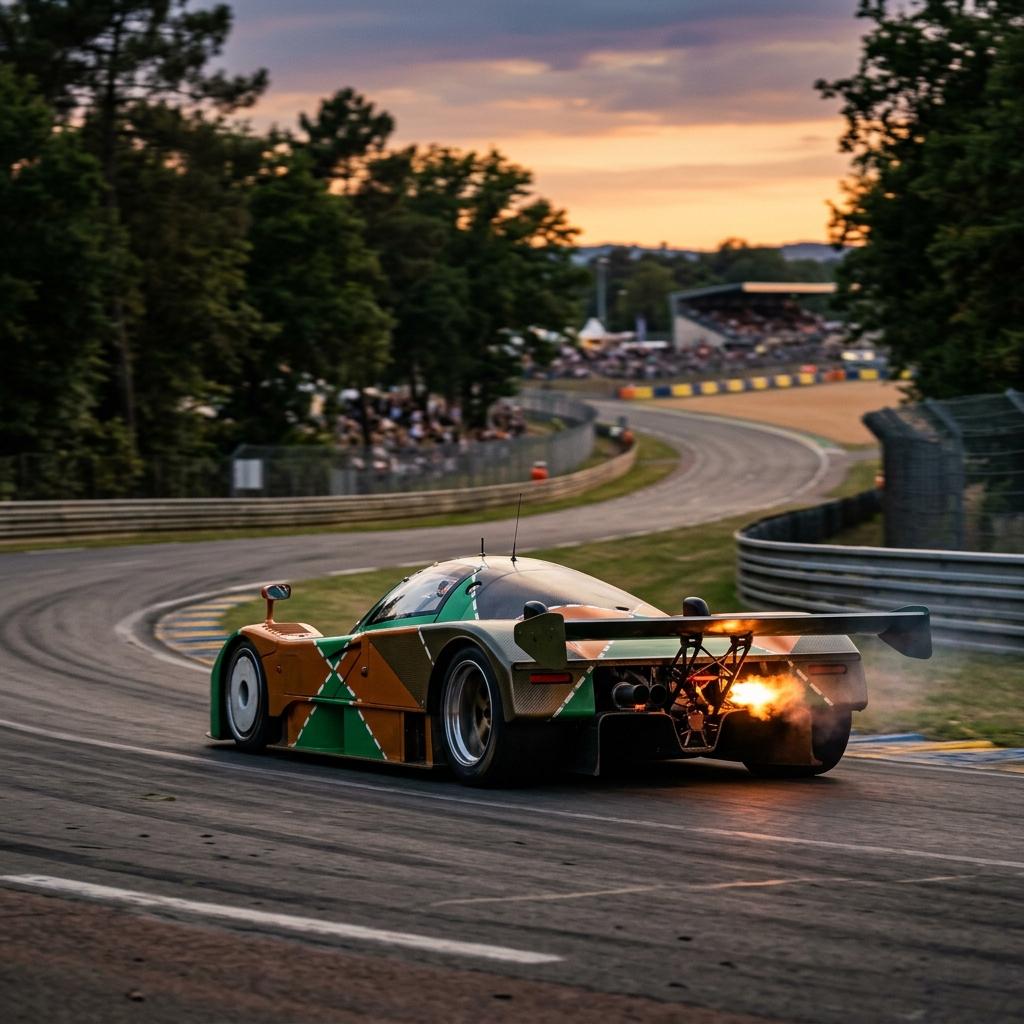
How Mazda achieved the impossible and won Le Mans with a unique quad-rotor engine.
The 1991 24 Hours of Le Mans is etched into motorsport history for one distinct, shrieking reason: the Mazda 787B. It remains one of the most famous, beloved, and mechanically unique race cars ever to turn a wheel in anger. By defying convention and utilizing a naturally aspirated rotary engine against a grid of established V8, V10, and V12 giants, Mazda achieved the impossible. The 787B didn't just win Le Mans; it became the first (and only) Japanese manufacturer to win the grueling endurance race until Toyota finally succeeded nearly three decades later.
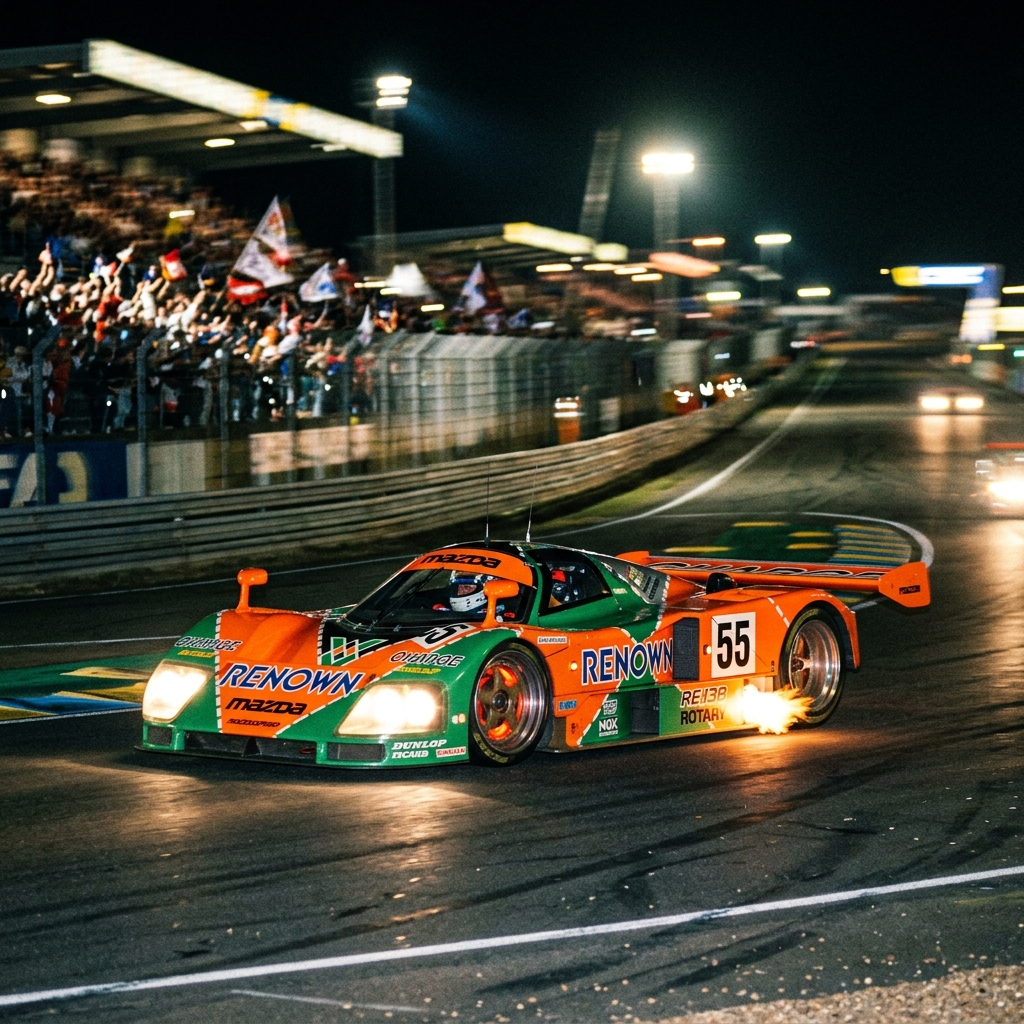
The Sound of Victory
Before you see a Mazda 787B, you hear it. The sound is an unmistakable, ear-splitting, high-pitched mechanical scream that physically vibrates through the grandstands. While the Jaguars growled and the Mercedes-Benz V8s thundered, the 787B shrieked at a terrifying 9,000 rpm. This unique auditory signature made it an instant crowd favorite, but that sound was a byproduct of an incredibly advanced, highly unorthodox powerplant.
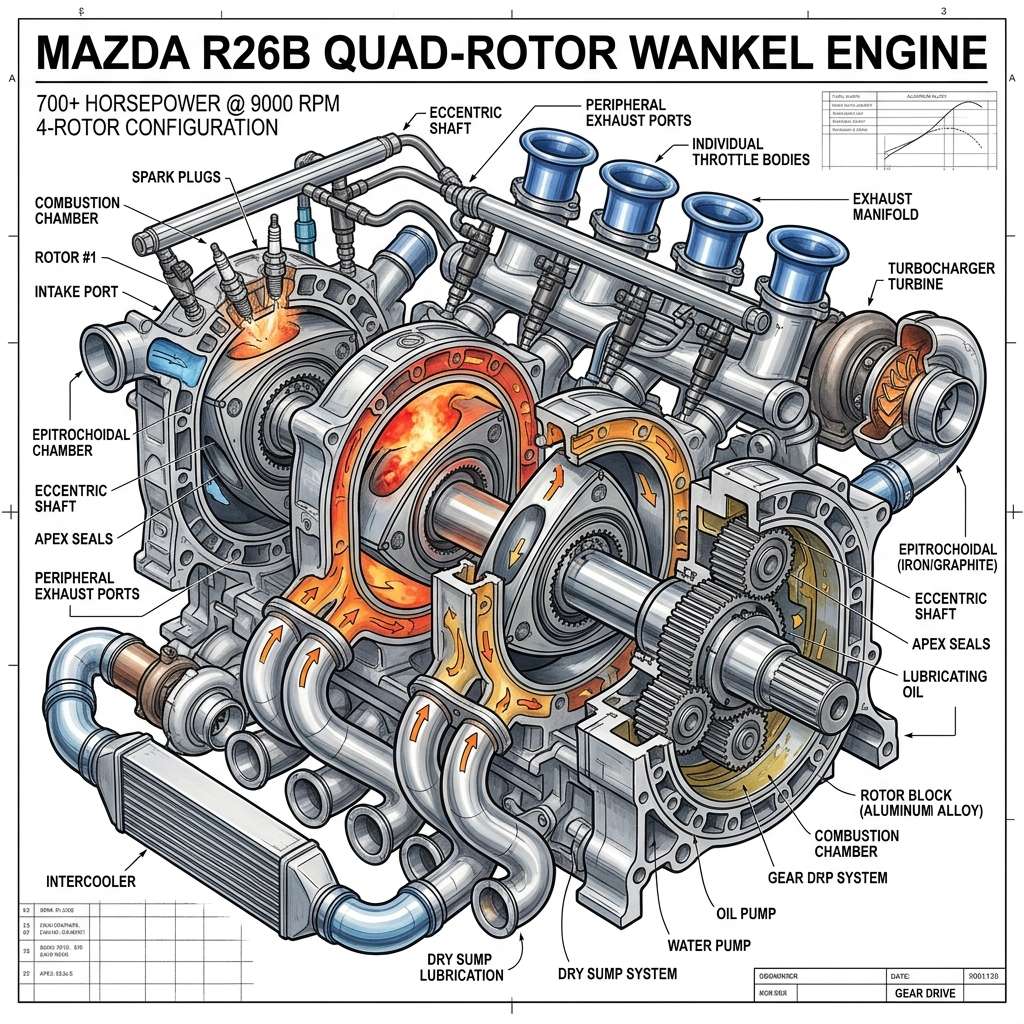
The Quad-Rotor R26B Engine
The heart of the 787B was the custom-built R26B engine. Unlike traditional piston engines, this was a Wankel rotary engine utilizing four rotors. Displacing just 2.6 liters, the engine produced a reliable 700 horsepower (though it was reportedly capable of over 900 hp if pushed to its absolute limits in qualifying trim).
The genius of the R26B was its continuous, smooth power delivery. Because rotaries have no reciprocating mass (pistons moving up and down), they can rev incredibly freely and smoothly. To maximize power across the rev range, Mazda engineers developed a continuously variable intake manifold. Telescoping intake runners would physically change length depending on engine RPM, optimizing the airflow and providing a broad, useable torque curve that was crucial for accelerating out of Le Mans' slow corners.
Lightweight Kevlar and Carbon Chassis
To complement the lightweight rotary engine, British designer Nigel Stroud designed an incredibly advanced chassis. The tub was constructed from a combination of carbon fiber and Kevlar, providing immense structural rigidity while keeping the overall weight to a minimum.
In racing trim, the 787B weighed a mere 830 kilograms (1,830 lbs). This extreme light weight, combined with carbon-ceramic brakes (which Mazda pioneered in endurance racing), allowed the car to brake much later and carry significantly more cornering speed than the heavier, more powerful Group C competitors.
The 1991 24 Hours of Le Mans
Entering the 1991 race, Mazda was an underdog. The grid was dominated by the heavily favored Mercedes-Benz C11s, Jaguar XJR-12s, and Peugeot 905s. The Number 55 Mazda 787B, driven by Johnny Herbert, Volker Weidler, and Bertrand Gachot, started from a modest 19th position.
However, the race is a test of endurance, not just outright speed. As the race progressed into the night, the favored Mercedes and Peugeots began suffering from mechanical failures and overheating issues. The 787B, painted in its iconic bright orange and green Renown livery, ran flawlessly. Its incredible fuel efficiency and light weight meant it was easier on its tires and brakes, requiring fewer pit stops. In the final hours of the race, the leading Mercedes broke down, handing the lead to the screaming Mazda. Johnny Herbert drove the final stint, crossing the finish line in first place, a victory so exhausting he collapsed upon exiting the car and missed the podium ceremony.
The Reliability Factor
Perhaps the most astonishing aspect of the 787B's victory was the post-race teardown. When Mazda engineers completely dismantled the winning R26B engine back in Japan, they discovered virtually no wear. The apex seals, rotors, and housings were in such perfect condition that the engine could have easily run another 24-hour race immediately. It was a staggering testament to Mazda's mastery of rotary engineering.
The Immediate Ban
The 787B’s reign was brief. Prior to the 1991 race, the FIA had already announced significant rule changes for the 1992 season, mandating 3.5-liter naturally aspirated piston engines (similar to Formula 1 cars) and effectively banning the rotary engine. The 787B's victory was the ultimate swan song—a final, glorious middle finger to the conventional piston engine establishment before the rules outlawed it forever.
Legacy of the 787B
Today, the Number 55 Mazda 787B is kept in working condition at the Mazda Museum in Hiroshima. It is occasionally brought out for demonstration runs at events like the Goodwood Festival of Speed, where its unmistakable scream continues to captivate new generations of fans. It stands as a monument to engineering audacity and the triumph of thinking differently.
Technical Specifications (1991 787B)
- Engine: 2.6-liter (2,616 cc) Custom R26B 4-Rotor Wankel
- Fuel System: Nippondenso Electronic Port Injection
- Power Output: 700 hp (522 kW) @ 9,000 rpm
- Torque: 448 lb-ft (607 Nm) @ 6,500 rpm
- Transmission: Porsche 5-speed manual
- Drivetrain: Rear-Wheel Drive
- Chassis: Carbon fiber and Kevlar composite monocoque
- Weight: 830 kg (1,830 lbs)
- Top Speed: ~210 mph (338 km/h) on the Mulsanne Straight
Sarah Velocity
Sarah Velocity is a contributing writer for Primedealsearch, bringing refined insights and expertise to our readers.