Genesis of Speed: The McLaren F1

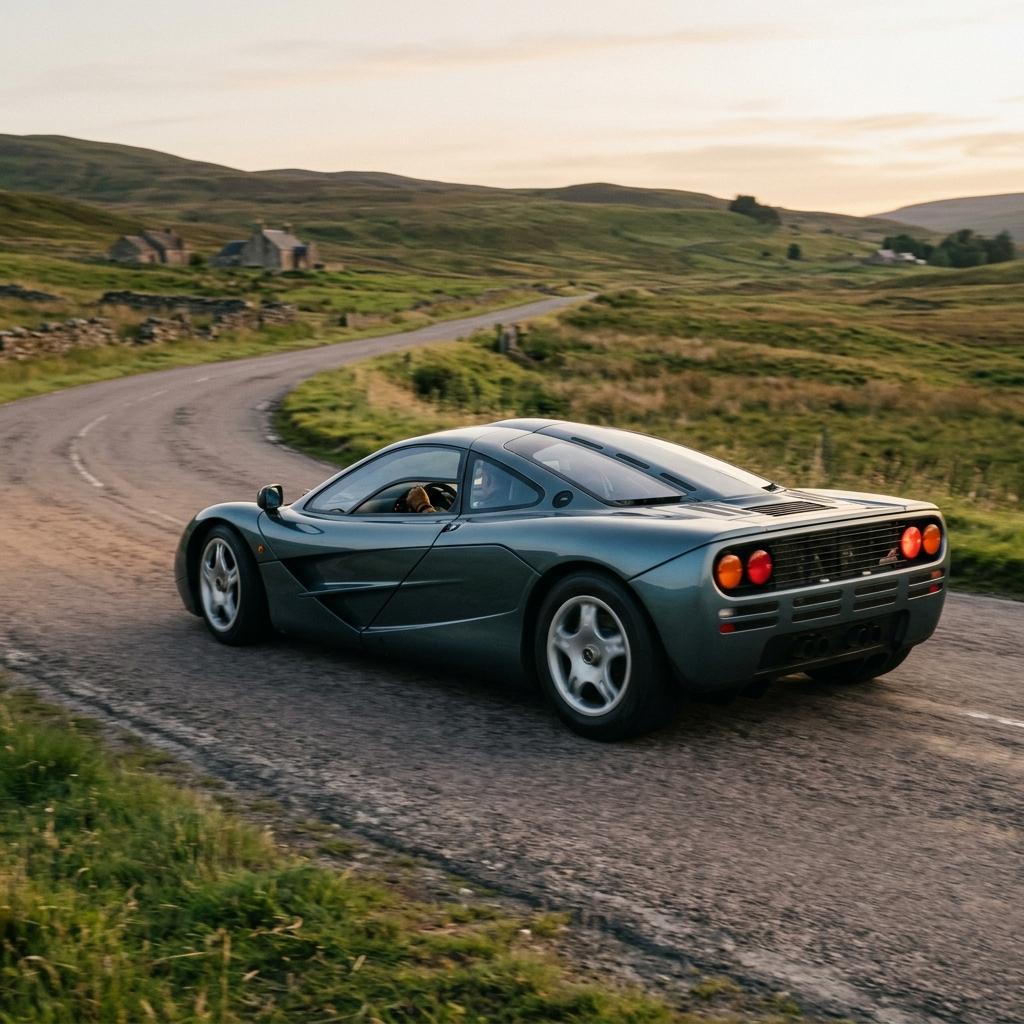
Gordon Murray's obsession with perfection produced the greatest road car of the twentieth century.
To fully comprehend the magnitude of the McLaren F1, one must understand that it was not built to compete with contemporary supercars; it was built to render them obsolete. Conceived in the late 1980s by Gordon Murray, the legendary Formula 1 designer, the McLaren F1 was an uncompromising pursuit of automotive perfection. When it debuted in 1992, it was so far ahead of its time technologically, dynamically, and financially that it completely redefined the parameters of the hypercar. Even today, over three decades later, many purists argue that it remains the greatest analog performance car ever constructed.
Gordon Murray's Blank Canvas
Following a wildly successful stint designing Formula 1 cars for Brabham and McLaren, Gordon Murray pitched a radical idea to Ron Dennis (the head of McLaren): use their F1 engineering expertise to build the ultimate road car.
Murray was given a blank check and absolute creative control. His philosophy was obsessive weight reduction, uncompromising packaging, and naturally aspirated power. He completely ignored the heavy turbochargers, all-wheel-drive systems, and power steering mechanisms that competitors like the Porsche 959 were utilizing. The F1 was the world's first production car to utilize a complete carbon-fiber reinforced polymer (CFRP) monocoque chassis, making it incredibly stiff and astonishingly light (weighing just 1,138 kg / 2,509 lbs).
The Central Driving Position
The most defining and unique feature of the McLaren F1 is its seating arrangement. Because Murray wanted the driver to have perfect visibility and ideal weight distribution (exactly like a Formula 1 car), the driver's seat is positioned perfectly in the center of the cabin.
Two passenger seats are positioned slightly behind and to the sides of the driver, making it a three-seater. This layout completely eliminates the offset pedal box issues common in right-hand or left-hand drive supercars and places the driver's mass exactly on the centerline of the vehicle.
The BMW S70/2 V12 Engine
Murray required an engine that was naturally aspirated, highly responsive, and reliable. After Honda (McLaren’s F1 partner at the time) declined to build a bespoke V12, Murray turned to Paul Rosche at BMW's M Division.
The result was the S70/2: a 6.1-liter, 60-degree V12 engine producing an incredible 618 horsepower and 479 lb-ft of torque. It featured variable valve timing (VANOS) and individual throttle bodies for instantaneous throttle response. Because the engine generated massive amounts of heat, and the carbon fiber chassis was susceptible to thermal degradation, the entire engine bay was famously lined with 16 grams of pure gold foil—the most efficient heat reflector available.
Le Mans Victory
Murray explicitly designed the F1 as the ultimate road car, with no intention of taking it racing. However, wealthy owners convinced McLaren to build a racing version (the F1 GTR) to compete in the BPR Global GT Series.
In 1995, several F1 GTRs were entered into the grueling 24 Hours of Le Mans. In a stunning display of reliability and speed, the lightly modified, road-car-based McLaren F1 completely dominated the purpose-built prototype race cars, finishing 1st, 3rd, 4th, 5th, and 13th overall. It remains one of the most remarkable victories in motorsport history.
The Ultimate Top Speed Record
In 1998, McLaren took an early prototype F1 (XP5) to the massive Ehra-Lessien test track in Germany to test its V-MAX. With the rev limiter raised slightly to 8,300 rpm and Le Mans-winner Andy Wallace behind the wheel, the naturally aspirated, rear-wheel-drive F1 hit a verified two-way average speed of 240.1 mph (386.4 km/h).
It was the fastest production car in the world, a record it held for seven years until it was finally broken by the Bugatti Veyron. Astonishingly, over a quarter-century later, the McLaren F1 still holds the absolute record as the fastest naturally aspirated production car in human history.
Technical Specifications (1992 McLaren F1)
- Engine: 6.1-liter (6,064 cc) BMW S70/2 V12, Naturally Aspirated
- Valvetrain: DOHC, 4 valves per cylinder with Dual VANOS
- Power Output: 618 hp (461 kW) @ 7,400 rpm
- Torque: 479 lb-ft (650 Nm) @ 5,600 rpm
- Transmission: 6-speed manual
- Drivetrain: Rear-Wheel Drive with Torsen Limited-Slip Differential
- Chassis: Carbon fiber monocoque
- Weight: Approx. 1,138 kg (2,509 lbs)
- 0-60 mph (0-100 km/h): 3.2 seconds
- Top Speed: 240.1 mph (386.4 km/h) (Record run)
Alex Driver
Alex Driver is a contributing writer for Primedealsearch, bringing refined insights and expertise to our readers.