Gullwing Grandeur: Mercedes-Benz 300 SL

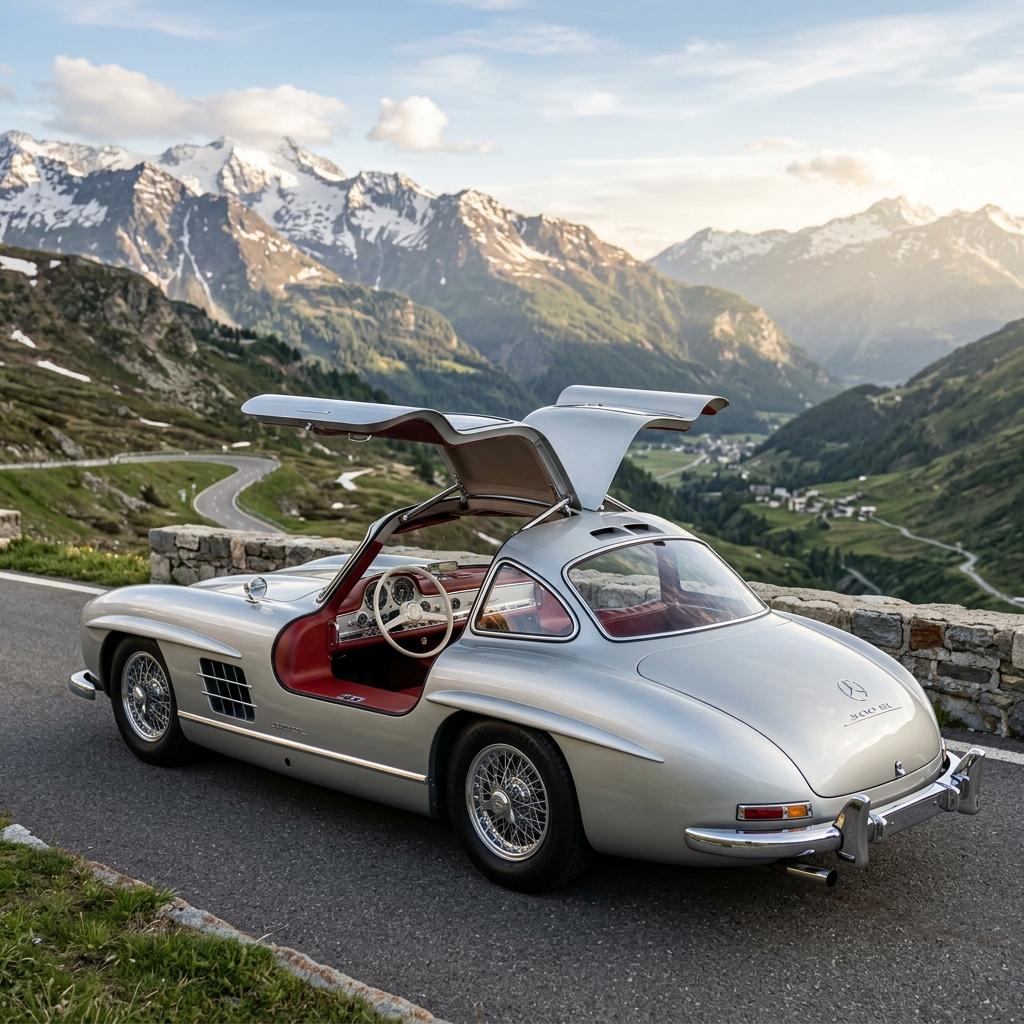
The story behind the iconic doors and the world's first production fuel injection system.
In the decimated landscape of post-World War II Germany, the idea that a company could emerge to build the fastest, most advanced, and arguably most beautiful sports car in the world seemed impossible. Yet, in 1954, Mercedes-Benz unveiled the 300 SL (Super-Leicht, or Super-Light). With its groundbreaking fuel-injected engine, revolutionary tubular frame, and unforgettable "Gullwing" doors, the 300 SL didn't just revive German automotive prestige; it arguably invented the concept of the modern supercar.
The Original Supercar
The origins of the 300 SL are deeply rooted in motorsport. In 1952, Mercedes-Benz returned to racing with the W194 sports racing car. It was incredibly successful, winning the 24 Hours of Le Mans, the Carrera Panamericana in Mexico, and the Eifelrennen at the Nürburgring.
Max Hoffman, the highly influential importer of European luxury cars to the United States, recognized the immense commercial potential of this race-winning machine. He convinced the Mercedes-Benz board of directors in Stuttgart that a street-legal version of the W194 would be a massive hit with wealthy American buyers. Mercedes agreed, and just a year and a half later, the production 300 SL (W198) debuted at the 1954 New York Auto Show—the first time Mercedes introduced a major model outside of Europe.
A Tubular Spaceframe Masterpiece
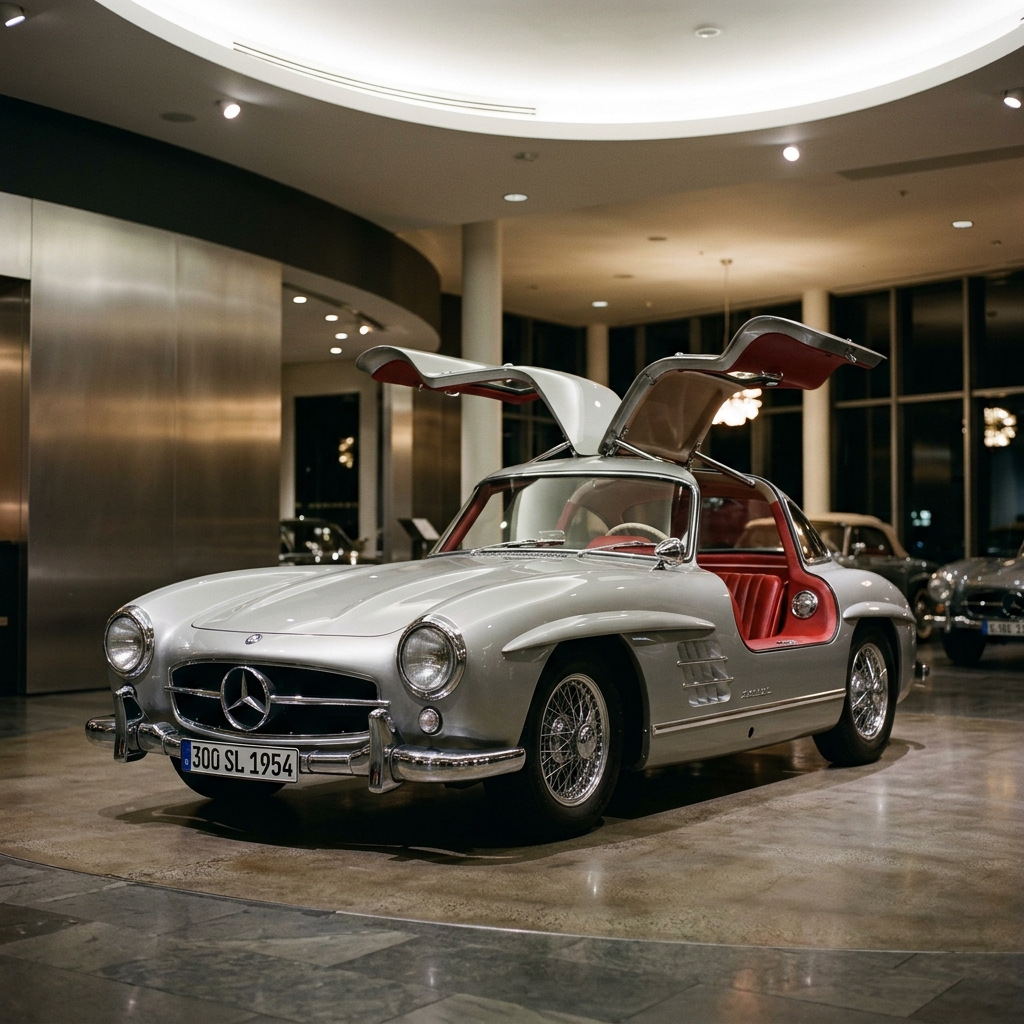
The defining feature of the 300 SL was hidden beneath its stunning aluminum and steel bodywork. To achieve maximum rigidity with minimal weight—essential for a race car utilizing a relatively heavy six-cylinder engine—chief engineer Rudolf Uhlenhaut designed an incredibly complex, lightweight welded tubular steel spaceframe chassis.
This spaceframe weighed just 82 kilograms (181 lbs) but was vastly stiffer than a traditional ladder frame. However, this engineering triumph created a significant design challenge: the tubular frame ran high along the sides of the car, making it impossible to install conventional side-hinged doors.
The Iconic Gullwing Doors
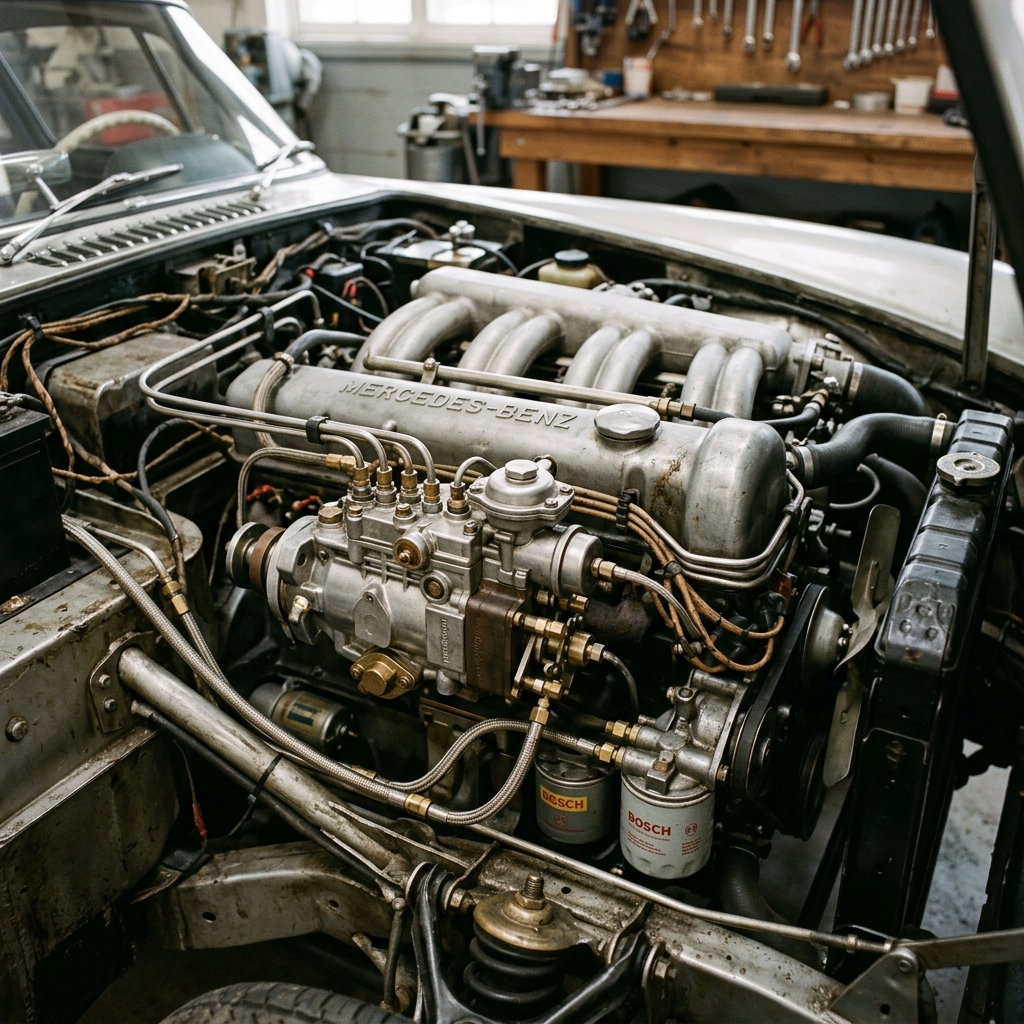
The solution to the high door sills became the 300 SL's most famous and defining characteristic. Mercedes engineers hinged the doors at the roofline, allowing them to swing upwards like the wings of a seagull.
Thus, the "Gullwing" was born. While they looked incredibly glamorous and futuristic, they were purely a functional engineering necessity born from the race car chassis. Getting in and out required a slightly undignified slide over the wide sill, and the steering wheel featured a pivoting mechanism that dropped it out of the way to allow the driver's legs to enter. Furthermore, because the doors occupied the roof, roll-down windows were impossible; the 300 SL featured small, removable perspex vent windows instead.
The First Direct Fuel Injection
The 300 SL wasn't just a pretty face; it possessed groundbreaking technology under the long hood. It was powered by a 3.0-liter, overhead-cam, inline-six engine tilted at a 50-degree angle to keep the hood line aerodynamically low.
More importantly, it was the first production passenger car in history to feature direct fuel injection. Developed by Bosch, this mechanical fuel injection system (originally designed for Messerschmitt fighter planes) injected fuel directly into the combustion chambers rather than through a carburetor. This innovation dramatically increased power, pushing the engine to produce 215 horsepower (a massive figure in 1954), while also improving efficiency.
From the Track to the Street
Thanks to its aerodynamic shape and powerful engine, the 300 SL was devastatingly fast. It was officially the fastest production car in the world at the time, capable of reaching a top speed of up to 163 mph (260 km/h) depending on the specified rear axle ratio.
It handled like a true race car, featuring independent front suspension and a swing-axle rear. The swing-axle, however, required respect; if a driver lifted off the throttle mid-corner, the rear suspension could "tuck in," causing sudden and severe oversteer.
Driving the 300 SL Today
Driving a 300 SL today is a visceral experience that transports you back to the 1950s. The cabin is incredibly hot due to the massive transmission tunnel radiating heat and the lack of roll-down windows. The mechanical fuel injection requires a specific starting procedure, and the unassisted drum brakes (disc brakes were introduced later on the Roadster version) demand strong leg pressure and anticipation. Yet, the sound of the injected inline-six, the precise mechanical gear shift, and the feeling of peering over the long, sculpted hood make it an unparalleled motoring event.
The Value and Collector Status
Production of the Gullwing coupe ended in 1957 after just 1,400 units were built (it was replaced by the more conventional, drop-top 300 SL Roadster).
Today, the Mercedes-Benz 300 SL Gullwing is absolute automotive royalty. It is the centerpiece of any serious blue-chip car collection. Because of its racing pedigree, technological firsts, and timeless, iconic design, perfect examples regularly command prices well over $1.5 million to $2 million at auction. It remains the ultimate symbol of mid-century automotive glamour and engineering brilliance.
Technical Specifications (1955 300 SL Coupe)
- Engine: 3.0-liter (2,996 cc) M198 Inline-6
- Valvetrain: SOHC, 2 valves per cylinder
- Fuel System: Bosch Mechanical Direct Fuel Injection
- Power Output: 215 hp (160 kW) @ 5,800 rpm
- Torque: 203 lb-ft (275 Nm) @ 4,600 rpm
- Transmission: 4-speed manual
- Drivetrain: Rear-Wheel Drive
- Chassis: Tubular steel spaceframe with steel/aluminum body
- Weight: Approx. 1,500 kg (3,300 lbs)
- 0-60 mph (0-100 km/h): ~8.5 seconds
- Top Speed: Up to 163 mph (260 km/h)
Sarah Velocity
Sarah Velocity is a contributing writer for Primedealsearch, bringing refined insights and expertise to our readers.