The King of the Ring: Nürburgring Nordschleife Records

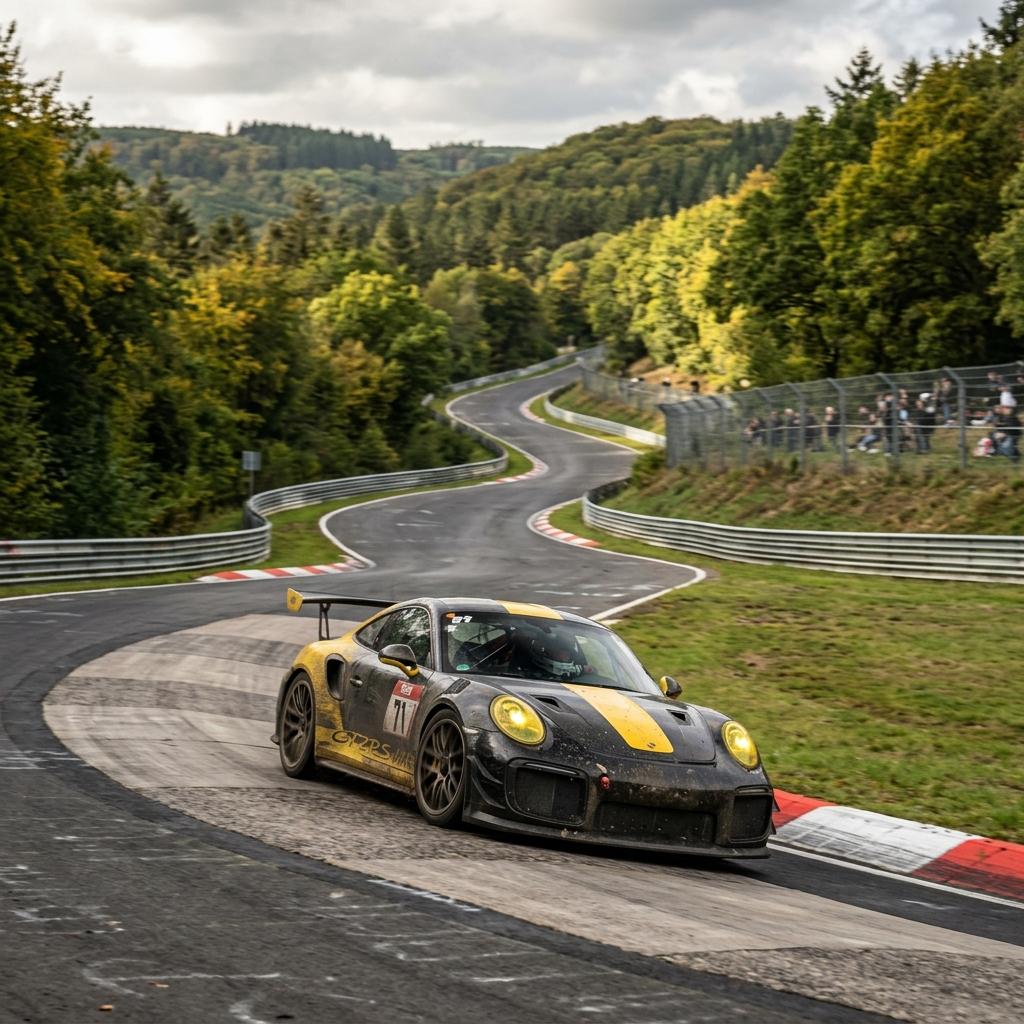
The Green Hell — 20.8 km of tarmac that separates legends from pretenders. A history of the world's most famous lap record.
Deep in the Eifel mountains of Germany lies a ribbon of tarmac that inspires equal parts reverence and absolute terror in the hearts of automotive engineers and racing drivers alike. It is the Nürburgring Nordschleife (North Loop). Over 20 kilometers (12.9 miles) long, featuring 73 treacherous corners, massive elevation changes, blind crests, and virtually no runoff areas, it is widely considered the most dangerous, demanding, and prestigious race circuit on Earth. Today, a lap time on the Nordschleife is the ultimate, undisputed metric by which the performance of a sports car is judged.
The Green Hell
Constructed in the 1920s as a way to stimulate the local economy and provide a testing ground for German automobile manufacturers, the Nordschleife was originally over 28 kilometers long. It winds its way through dense, ancient pine forests, leading to its famous moniker.
The legendary Scottish Formula 1 World Champion, Sir Jackie Stewart, famously dubbed the track "The Green Hell" (Die Grüne Hölle). The name perfectly encapsulated the track's nature: breathtakingly beautiful but inherently deadly. The weather is notoriously unpredictable; it can be sunny and dry at the start line, and pouring rain or foggy at the highest points of the circuit. The track surface features bumps, jumps (where cars frequently leave the ground), and banking, placing immense stress on every single component of a vehicle.
Jackie Stewart's Warning
For decades, the Nordschleife hosted the Formula 1 German Grand Prix. However, as F1 cars became exponentially faster in the late 1960s and 1970s, the track became indefensibly dangerous. The safety barriers (often just hedges or simple armco) were inadequate, and the track was so long that medical response times in the event of a crash were dangerously slow.
Following a horrific, fiery crash by Niki Lauda in 1976 (which he narrowly survived), Formula 1 permanently abandoned the Nordschleife, moving to the safer, modernized Hockenheimring and eventually the much shorter Nürburgring Grand Prix circuit.
The Ultimate Proving Ground
While prototype racing abandoned the long loop, automotive manufacturers realized its unparalleled value as a testing facility. A lap of the Nordschleife subjects a car to a lifetime of stress in under ten minutes.
If a car's chassis lacks rigidity, the Nordschleife will expose it. If the suspension damping is poor, the bumps and jumps will unsettle the car. If the brakes lack thermal capacity, the massive decelerations will boil the brake fluid. "Ring-tested" became a badge of honor, assuring customers that the car's engineering had survived the ultimate crucible.
The 7-Minute Barrier
For production cars, the Nordschleife lap record became the ultimate marketing tool. The progression of these records maps the dramatic evolution of automotive technology.
For years, breaking the 8-minute barrier was the hallmark of a serious supercar (achieved by cars like the Nissan Skyline R33 GT-R). But the true holy grail became the 7-minute barrier. It seemed physically impossible for a street-legal car on road tires to average the required speeds. However, in 2013, the Porsche 918 Spyder shattered the psychological barrier, posting an astonishing time of 6 minutes and 57 seconds.
The Production Car Lap Record Arms Race
Following the 918's achievement, an all-out arms race erupted. Lamborghini brought their active-aerodynamics-equipped Huracán Performante and later the Aventador SVJ, pushing the time down to 6:44.97. Porsche responded with the track-focused 911 GT2 RS MR, achieving a staggering 6:38.83.
Most recently, the Mercedes-AMG One—a hypercar utilizing a genuine, literal Formula 1 engine—smashed the production car record, setting a scarcely believable time of 6:35.183.
While purists argue that manufacturer lap times can be manipulated (using bespoke tires, removing weight, or perfectly ideal weather conditions), the Nordschleife remains the ultimate, undisputed battleground. It is the only place on Earth where horsepower, aerodynamics, suspension geometry, and sheer driver bravery are tested simultaneously to their absolute limits.
Key Milestone Records
- 1983 (Racing Prototype): Stefan Bellof drives a Porsche 956 C to a qualifying time of 6:11.13, a record that stood for an astonishing 35 years.
- 2018 (Absolute Record): Timo Bernhard drives the unrestricted Porsche 919 Hybrid Evo to an unbelievable time of 5:19.546, averaging nearly 145 mph (233 km/h).
- 2013 (Production Car Sub-7): Porsche 918 Spyder (6:57.00) breaks the 7-minute barrier.
- 2022 (Current Production Record): Mercedes-AMG One achieves 6:35.183, the fastest time ever for a street-legal vehicle.
Sarah Velocity
Sarah Velocity is a contributing writer for Primedealsearch, bringing refined insights and expertise to our readers.