Pagani Zonda: Art Gallery on Wheels

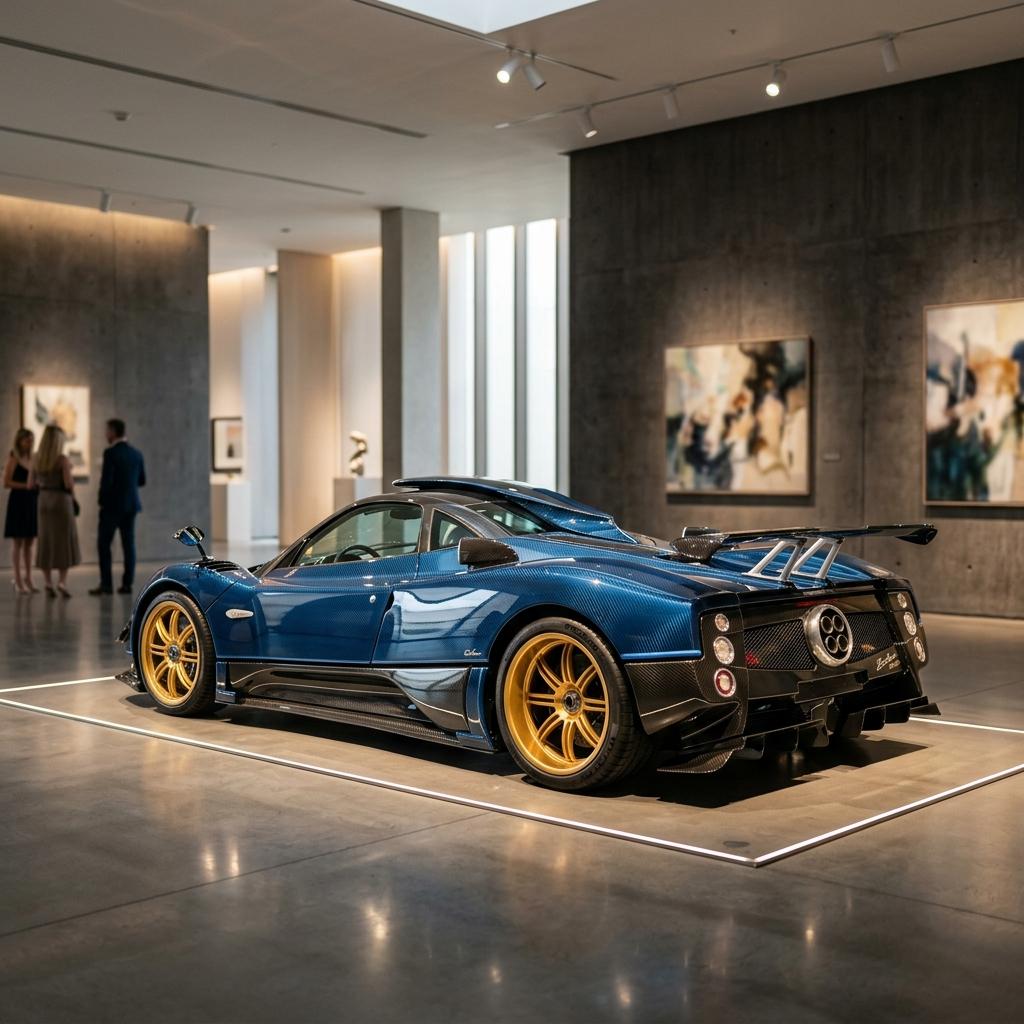
Horacio Pagani's obsession with beauty and engineering perfection created a hypercar unlike anything before or since.
When Horacio Pagani, a former Lamborghini engineer, founded his own boutique supercar company in Modena, Italy, he didn't just want to build fast cars; he wanted to build mechanical art. The result of his vision was the Pagani Zonda. Introduced at the 1999 Geneva Motor Show, the Zonda shocked the established automotive hierarchy. It combined a bespoke, Formula 1-inspired carbon fiber chassis with an operatic Mercedes-AMG V12 engine and a level of interior craftsmanship that resembled a Swiss watch more than an automobile. It remains one of the most uniquely beautiful and exhilarating hypercars ever created.
Horacio Pagani's Masterpiece
Horacio Pagani was a pioneer in carbon fiber technology. While at Lamborghini, he managed the composites department and was instrumental in creating the Countach Evoluzione concept. However, when Lamborghini refused to invest in an autoclave (a specialized oven for curing carbon fiber), Pagani bought his own and eventually left to start his own company.
The Zonda C12 was his first creation. Its design was heavily inspired by Group C endurance racing cars (specifically the Sauber-Mercedes C9) and jet fighters. The cab-forward design, the dramatically sloping nose, the exposed carbon fiber details, and the iconic central quad-exhaust cluster immediately set it apart from anything Ferrari or Lamborghini was producing at the time.
AMG V12 Power
Pagani knew that developing a proprietary engine from scratch would bankrupt his fledgling company. Through a personal connection made by the great Formula 1 driver Juan Manuel Fangio, Pagani secured an agreement to use exclusively tailored V12 engines built by Mercedes-AMG.
The early Zondas utilized a 6.0-liter V12 producing a modest 389 horsepower. However, as the Zonda evolved, so did the engines. The Zonda S received a 7.0-liter unit, and the legendary Zonda F (named in honor of Fangio) featured a 7.3-liter AMG V12 producing 594 horsepower. These naturally aspirated engines were renowned for their immense low-end torque and a high-pitched, screaming exhaust note that sounded like an angry Formula 1 car echoing through an Italian valley.
Carbon-Titanium Construction
As production continued, Pagani pushed the boundaries of material science. For the Zonda Cinque (of which only five coupes and five roadsters were built), he introduced a revolutionary new material: Carbotanium.
By weaving titanium wire directly into the carbon fiber fabric, Pagani created a composite that possessed the extreme rigidity and light weight of carbon fiber, but with the yielding strength of titanium (preventing the carbon from shattering upon severe impact). This made the chassis incredibly stiff, allowing the pushrod suspension to work with absolute precision, making the Zonda a devastatingly fast track car.
The Zonda R
The ultimate expression of the Zonda's performance potential was the Zonda R. It was a track-only weapon, sharing only 10% of its components with the road-going Zondas. It featured a longer wheelbase, massive aerodynamic wings, a roof scoop, and a 6.0-liter V12 engine derived from the Mercedes-Benz CLK GTR race car, producing 740 horsepower.
Unburdened by emissions or noise regulations, the Zonda R was terrifyingly loud and brutally fast. In 2010, it lapped the Nürburgring Nordschleife in an astonishing 6 minutes and 47 seconds, firmly establishing Pagani as a manufacturer capable of producing world-beating track cars.
Art Gallery on Wheels
What truly elevates the Zonda from a mere supercar to a rolling masterpiece is the interior. Horacio Pagani obsessively designed every single component. The air vents resemble jet engine exhausts. The instrument cluster looks like a bespoke chronometer. Every toggle switch, pedal, and dial is milled from solid blocks of aluminum or titanium. The leather is supplied by the finest Italian artisans.
Driving a Zonda is a tactile and visual experience unlike any other. It is an uncompromised vision of automotive passion—a car built without the constraints of corporate focus groups or strict budget limitations. It is the ultimate manifestation of the hypercar as art.
Technical Specifications (Zonda F)
- Engine: 7.3-liter (7,291 cc) Mercedes-AMG V12, Naturally Aspirated
- Valvetrain: DOHC, 4 valves per cylinder
- Power Output: 594 hp (443 kW) @ 6,150 rpm
- Torque: 560 lb-ft (760 Nm) @ 4,000 rpm
- Transmission: 6-speed manual
- Drivetrain: Rear-Wheel Drive
- Chassis: Carbon fiber central tub with tubular steel subframes
- Weight: Approx. 1,230 kg (2,711 lbs)
- 0-60 mph (0-100 km/h): 3.6 seconds
- Top Speed: 214 mph (345 km/h)
Marcus Gear
Marcus Gear is a contributing writer for Primedealsearch, bringing refined insights and expertise to our readers.