The Rise of Electric Performance: Porsche Taycan Turbo S

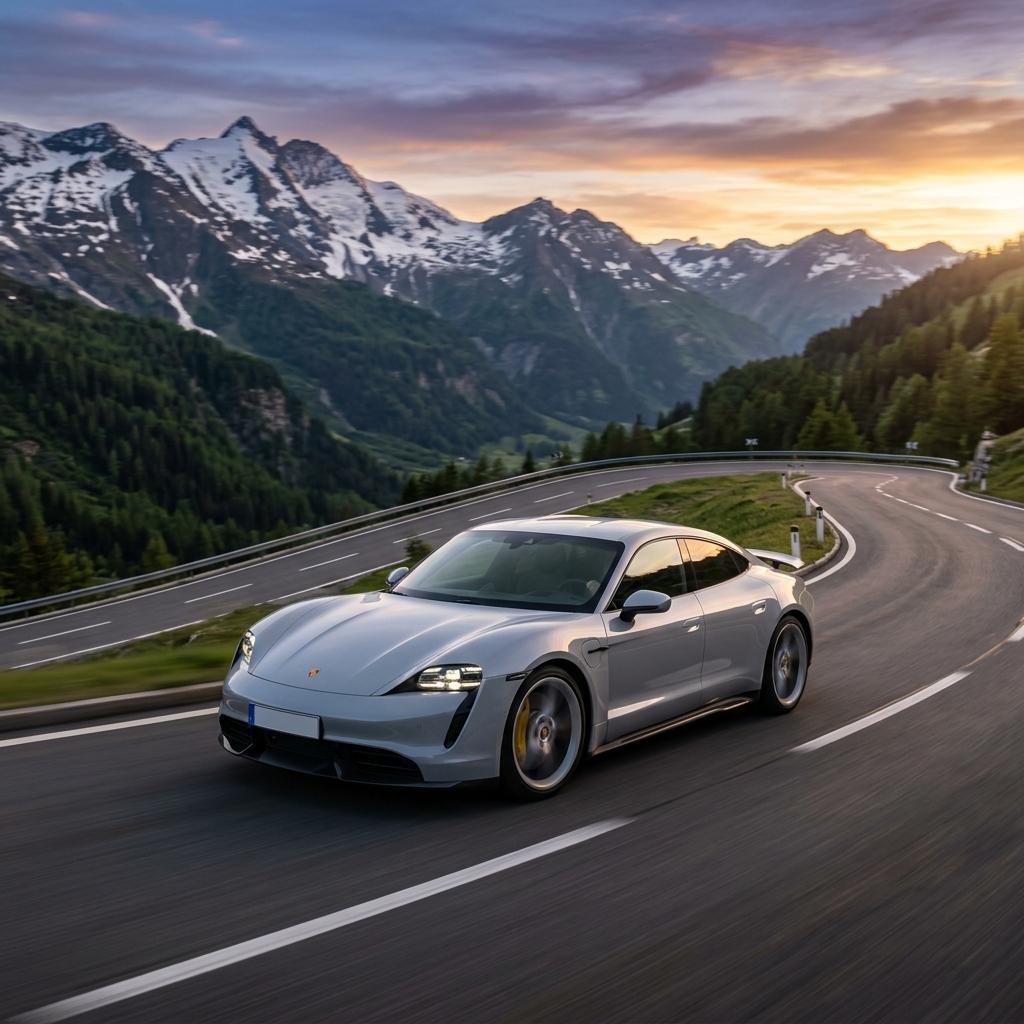
Porsche proved that electric cars can be genuinely exciting to drive by creating a sports saloon that handles better than most combustion cars.
When the automotive industry realized that electrification was an inevitability rather than a passing trend, traditional sports car manufacturers faced an existential crisis. How do you build an electric vehicle (EV) that doesn't just accelerate quickly, but possesses the soul, handling, and repeatable performance expected of a legendary sports car brand? Porsche's answer was the Taycan. Unveiled in 2019, the Taycan (specifically the flagship Turbo S variant) didn't just prove that EVs could be exciting; it fundamentally redefined the parameters of electric performance, forcing the rest of the industry to play catch-up.
The Mission E Concept
The story of the Taycan began in 2015 with the stunning "Mission E" concept car. Porsche promised that this sleek, low-slung electric four-door would not be compromised by heavy batteries or range anxiety, and would deliver the authentic driving dynamics of a Porsche 911.
While companies like Tesla had already proven that EVs could be devastatingly fast in a straight line, they often suffered from thermal degradation—meaning after one or two hard launches or a lap of a racetrack, the batteries and motors would overheat, significantly reducing power. Porsche explicitly engineered the Taycan to solve this problem, demanding repeatable, unrelenting performance.
800-Volt Architecture
The core technological breakthrough of the Taycan is its electrical architecture. While nearly every other EV on the market (including Tesla) utilized a 400-volt system, Porsche engineered the Taycan around an 800-volt system.
This decision was monumental. Doubling the voltage meant that the current flowing through the car's wiring could be halved while delivering the same power. This allowed Porsche to use significantly thinner, lighter wiring harnesses, saving crucial weight. More importantly, it dramatically reduced the heat generated by the electrical system. This superior thermal management is what allows the Taycan Turbo S to execute aggressive launch-control starts over and over again without any degradation in performance, and allows for incredibly fast DC charging speeds (up to 270 kW), capable of charging the battery from 5% to 80% in just 22 minutes.
The Two-Speed Transmission
Another major engineering departure was the drivetrain. Most EVs utilize a simple single-speed transmission because electric motors have a massive, flat torque curve.
Porsche, however, equipped the rear motor of the Taycan with a unique, automated two-speed gearbox. First gear has a very short ratio, providing the violent, neck-snapping acceleration required for a sub-3-second 0-60 mph launch. Around 50 mph, the transmission shifts seamlessly into the taller second gear, which improves efficiency at highway cruising speeds and allows the Taycan to achieve its high 161 mph (260 km/h) top speed without over-revving the electric motors.
Savage Acceleration
The Taycan Turbo S (a nomenclature that drew some criticism since EVs obviously do not have turbochargers, but aligns with Porsche’s historical trim hierarchy) is a violently fast automobile.
It features two permanent magnet synchronous motors (one on the front axle, one on the rear), providing highly advanced all-wheel drive. During launch control "Overboost," the system produces a staggering 750 horsepower (560 kW) and 774 lb-ft (1,050 Nm) of torque. Because the traction control system reacts 10 times faster than a combustion engine system, the Taycan launches with zero wheelspin. It achieves 0-60 mph in a verified 2.6 seconds, delivering G-forces that genuinely leave passengers breathless.
Maintaining the Porsche DNA
Despite weighing a massive 2,300 kg (5,100 lbs) due to its 93.4 kWh battery pack, the Taycan drives like a true Porsche. The heavy batteries are mounted perfectly flat in the floorboard, giving the Taycan a lower center of gravity than a Porsche 911.
Equipped with three-chamber adaptive air suspension, active roll stabilization (PDCC), and rear-wheel steering, the Taycan brilliantly masks its weight. It corners incredibly flat, changes direction with agility, and provides genuine feedback through the steering wheel. It proved to the world that the transition away from internal combustion does not mean the death of the driver's car. The Porsche Taycan is a technological masterpiece, setting the dynamic benchmark for the electric era.
Technical Specifications (Taycan Turbo S)
- Powertrain: Dual Permanent Magnet Synchronous Motors
- Battery: 93.4 kWh Performance Battery Plus (800-Volt Architecture)
- Power Output: 750 hp (560 kW) with Overboost
- Torque: 774 lb-ft (1,050 Nm)
- Transmission: Single-speed front, Two-speed rear automatic
- Drivetrain: All-Wheel Drive
- Chassis: Aluminum-steel hybrid unibody with structural battery pack
- Weight: Approx. 2,295 kg (5,060 lbs)
- 0-60 mph (0-100 km/h): 2.6 seconds
- Top Speed: 161 mph (260 km/h)
Alex Driver
Alex Driver is a contributing writer for Primedealsearch, bringing refined insights and expertise to our readers.