The Renault Alpine A110: French Finesse on Mountain Roads

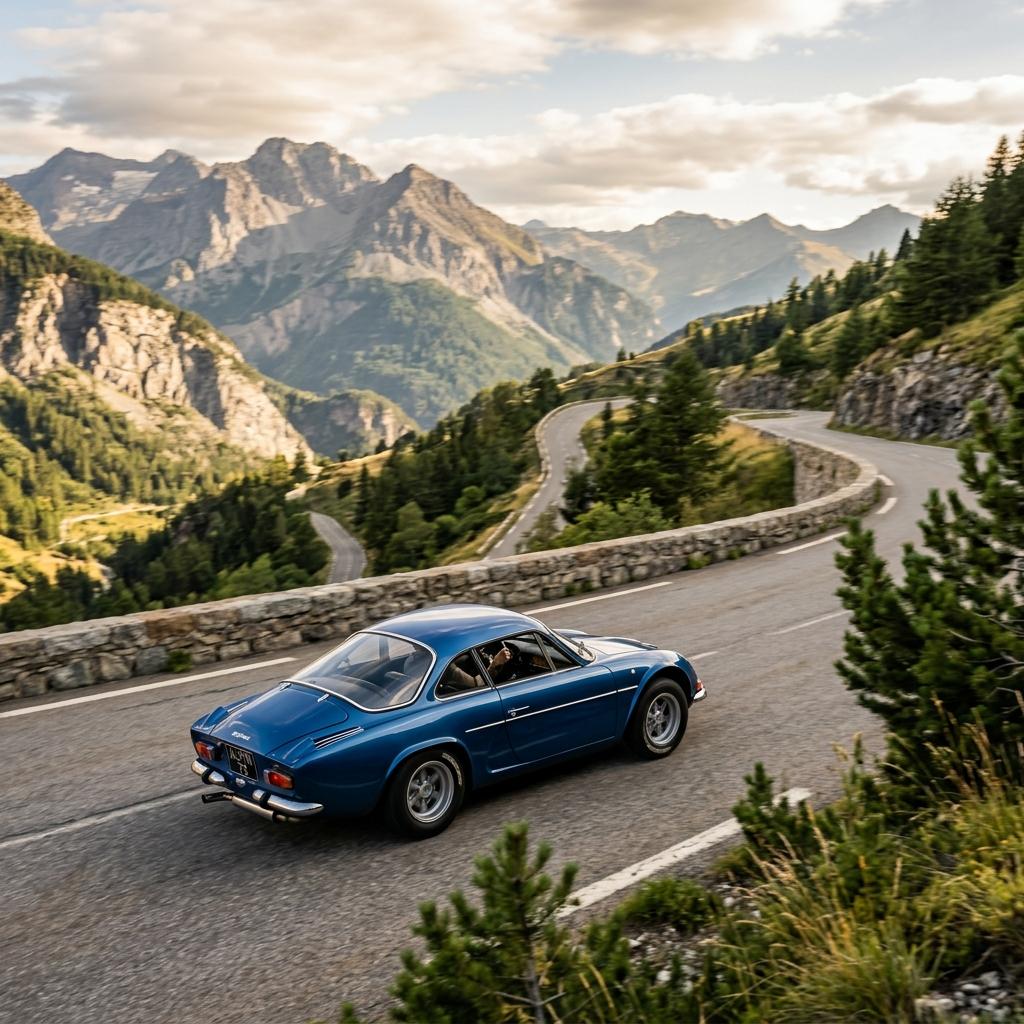
Small, light, and devastatingly quick through corners — the original A110 is France's greatest sports car.
When discussing the greatest rallying machines of all time, the conversation inevitably turns to the thunderous Audi Quattros or the terrifying Group B Lancias. However, the car that effectively laid the foundation for the World Rally Championship wasn't a fire-breathing monster; it was a tiny, incredibly beautiful, fiberglass-bodied French sports car: the Renault Alpine A110. Nicknamed the "Berlinette," the A110 relied on extreme lightness, rear-engine traction, and exquisite balance to conquer the snowy passes of the Alps and establish itself as a true motorsport legend.
The French Rally Pioneer
Alpine was founded in 1955 by Jean Rédélé, an ambitious French garage owner and amateur racer who achieved significant success modifying Renault 4CVs. His philosophy was simple: mechanical components sourced from mass-produced Renaults, wrapped in lightweight, aerodynamic fiberglass bodies.
Introduced in 1961, the A110 was the ultimate evolution of Rédélé's vision. Penned by Giovanni Michelotti, the design was stunning—a sleek, impossibly low coupe characterized by its covered headlights and dramatically swooping rear end. Underneath the gorgeous fiberglass body was a rigid steel backbone chassis, a design that provided immense strength while keeping the overall weight to a barely believable 700 kilograms (1,540 lbs).
Rear-Engine Agility
The defining mechanical characteristic of the A110 was its layout. Much like the Porsche 911, the A110 featured a rear-mounted engine positioned entirely behind the rear axle. Initially powered by modest 1.1-liter Renault engines, later competition versions utilized a highly tuned 1.6-liter (and eventually 1.8-liter) inline-four producing roughly 140 horsepower.
While 140 horsepower sounds meager today, in a car weighing just 700 kg, it was explosive. The rear-engine layout provided immense traction under acceleration, allowing the A110 to dig into snow, ice, and gravel with remarkable efficiency. Because the front end was so light, the steering was razor-sharp and communicative, allowing drivers to "dance" the car through tight alpine hairpins using the throttle to pivot the heavy rear end.
Winning the First WRC
Throughout the late 1960s and early 1970s, the Alpine A110 was a dominant force in European rallying, heavily backed by the Renault factory. Its crowning achievement arrived in 1973—the inaugural year of the newly formed World Rally Championship (WRC) for manufacturers.
The A110, painted in its iconic French Racing Blue, absolutely decimated the competition. It famously scored a spectacular 1-2-3 sweep at the treacherous Monte Carlo Rally. By the end of the 1973 season, Alpine-Renault had secured the very first WRC Manufacturers' title, cementing the Berlinette's legacy as a giant-killer capable of defeating much larger and more powerful cars from Porsche and Lancia.
The Rebirth in 2017
Production of the original A110 ended in 1977 as the car became outclassed by newer mid-engine designs like the Lancia Stratos. The Alpine name lay largely dormant for decades.
However, in 2017, Renault shocked the automotive world by resurrecting the Alpine A110. The modern A110 is a brilliant piece of neo-retro design, capturing the unmistakable silhouette of the original. Crucially, Renault engineers stayed absolutely true to Jean Rédélé's original philosophy. Instead of competing in horsepower wars, they focused on weight.
The Modern Lightweight Hero
The modern A110 features an all-aluminum chassis and body, making it one of the lightest sports cars on the market (weighing just 1,080 kg / 2,380 lbs). It utilizes a mid-mounted (rather than rear-mounted) 1.8-liter turbocharged engine producing 252 horsepower (up to 300 hp in the A110 S variant).
In an era where sports cars are increasingly bloated, digitized, and heavy, the modern A110 is widely celebrated by automotive journalists as a revelation. It prioritizes fluid handling, supple suspension (eschewing the bone-jarring stiffness of modern rivals), and pure driver engagement. Both the 1973 original and the 2017 rebirth prove that true automotive joy is found not in a massive engine, but in the delicate, beautiful balance of a lightweight chassis on a twisting mountain road.
Technical Specifications (1973 Alpine A110 1600S)
- Engine: 1.6-liter (1,565 cc) Renault Inline-4, Naturally Aspirated
- Valvetrain: OHV, 2 valves per cylinder
- Fuel Delivery: Two Weber 45 DCOE carburetors
- Power Output: 138 hp (103 kW) @ 6,000 rpm
- Torque: 106 lb-ft (144 Nm) @ 5,000 rpm
- Transmission: 5-speed manual
- Drivetrain: Rear-Engine, Rear-Wheel Drive
- Chassis: Steel backbone chassis with fiberglass body
- Weight: Approx. 700 kg (1,540 lbs)
- 0-60 mph (0-100 km/h): ~6.3 seconds
- Top Speed: 130 mph (210 km/h)
Marcus Gear
Marcus Gear is a contributing writer for Primedealsearch, bringing refined insights and expertise to our readers.