The Subaru Impreza WRX STI: Blue Oval Perfection

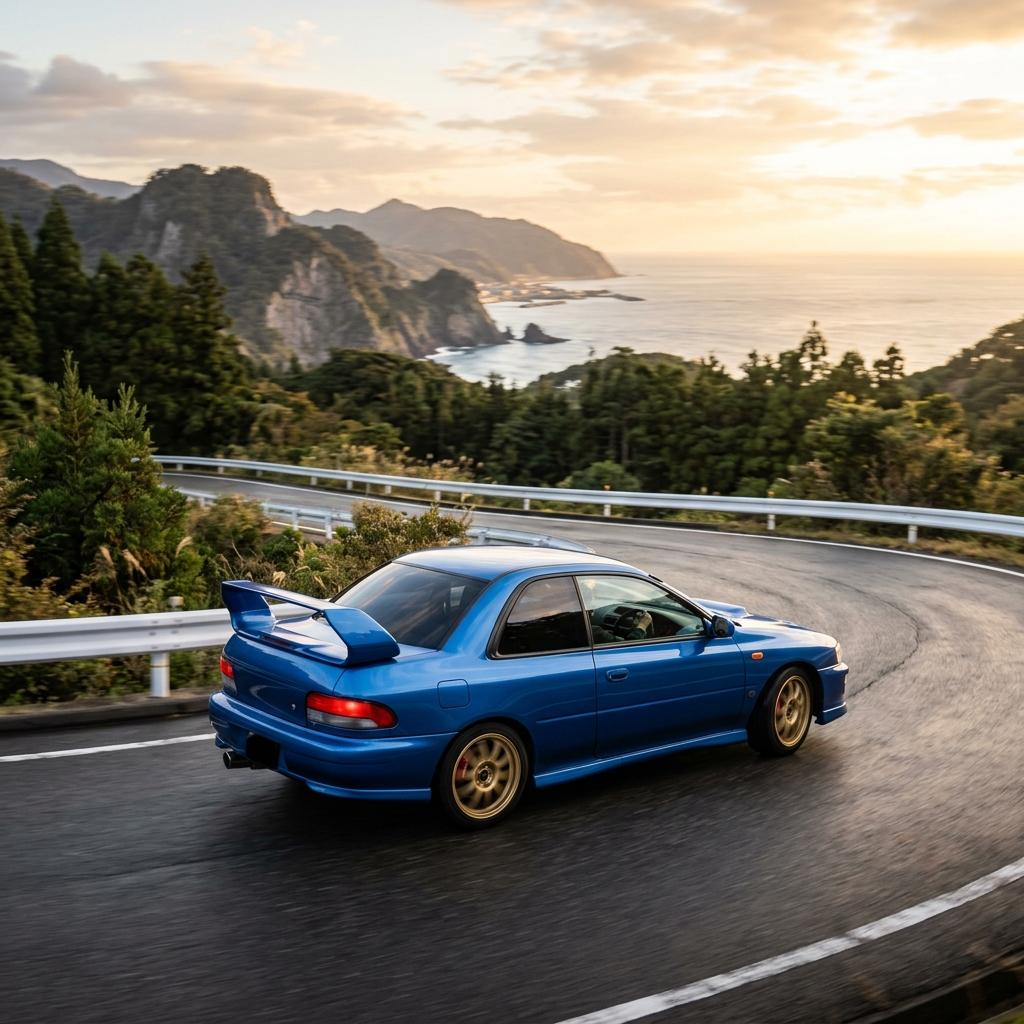
Three WRC world titles and an undying fanbase. The STI remains the benchmark for all-weather performance.
For nearly three decades, if you wanted a practical, relatively affordable sedan that could comfortably transport your family to the grocery store on a Tuesday and absolutely demolish a twisting, snow-covered mountain pass on a Sunday, your primary choice was the Subaru Impreza WRX STI. Born from the unforgiving crucible of the World Rally Championship (WRC), the STI wasn't just a car; it was a blue-collar hero characterized by its unmistakable boxer engine rumble, massive rear wing, and gold wheels. It proved that Japanese engineering could conquer the toughest rally stages on Earth.
The 22B STI
The Subaru Tecnica International (STI) division was created in 1988 to manage Subaru's motorsport activities. In 1994, they released the first Impreza WRX STI, a highly tuned version of the standard WRX.
The absolute zenith of the first-generation Impreza (and arguably the greatest Subaru ever built) arrived in 1998: the legendary 22B STI. Built to celebrate Subaru's 40th anniversary and their third consecutive WRC Manufacturers' title, the 22B was a wide-body, two-door coupe masterpiece. It featured a unique 2.2-liter version of the flat-four engine, a seam-welded chassis for immense rigidity, and a bespoke Bilstein suspension. Only 400 were built for the Japanese market, and they sold out in a matter of hours. Today, the 22B is a blue-chip collector's item, commanding prices well over $300,000.
Symmetrical All-Wheel Drive
The cornerstone of the STI's capability is Subaru’s "Symmetrical All-Wheel Drive" system. Unlike many AWD systems that are adapted from front-wheel-drive platforms, the Impreza was designed from the ground up to be AWD.
The entire drivetrain (engine, transmission, driveshaft, and rear differential) is mounted in a perfectly straight, symmetrical line down the center of the car. This provides an exceptionally low center of gravity and perfect side-to-side weight distribution. Combined with the Driver Controlled Center Differential (DCCD)—which allows the driver to manually adjust the torque split between the front and rear axles—the STI offers a level of mechanical grip and handling predictability that is unparalleled on loose surfaces.
The Boxer Engine Rumble
Powering the STI is a horizontally opposed "boxer" engine (specifically, the EJ-series for the majority of its lifespan). In a boxer engine, the pistons move horizontally toward and away from each other, canceling out primary vibrations and keeping the engine block incredibly low in the chassis.
The engine utilizes unequal length exhaust headers (in earlier models), which causes the exhaust pulses to arrive at the turbocharger at slightly different intervals. This creates the unmistakable, deep, throbbing "Subaru rumble"—a sound instantly recognizable to any car enthusiast from a mile away. While later generations eventually switched to equal length headers for efficiency, the traditional rumble remains deeply tied to the car's identity.
Colin McRae and the WRC
The Subaru Impreza STI's global fame is intrinsically linked to the legendary Scottish rally driver, Colin McRae. In the mid-1990s, driving the iconic blue and yellow 555-liveried Impreza, McRae defined an era of rallying.
His "if in doubt, flat out" driving style, characterized by massive, aggressive power slides, perfectly showcased the capabilities of the STI platform. McRae won the World Rally Championship in 1995, transforming the Impreza from an obscure Japanese sedan into a global performance icon and inspiring an entire generation of video game players and driving enthusiasts.
The Rally Rivalry
For over twenty years, the automotive landscape was defined by one of the fiercest rivalries in history: the Subaru WRX STI versus the Mitsubishi Lancer Evolution. The two cars traded blows on rally stages and in dealership showrooms globally.
If the Evo was perceived as the sharper, more technologically complex scalpel, the STI was the brutish, highly communicative sledgehammer. While Mitsubishi eventually killed the Evolution in 2016, Subaru continued producing the STI until 2021. The STI remains a testament to the golden era of homologation rally cars—a machine that brought the thrill of the WRC to the public roads.
Technical Specifications (2004 Impreza WRX STI 'Blobeye')
- Engine: 2.5-liter (2,457 cc) EJ257 Turbocharged Boxer 4-Cylinder
- Valvetrain: DOHC, 4 valves per cylinder with AVCS
- Power Output: 300 hp (224 kW) @ 6,000 rpm (US Spec)
- Torque: 300 lb-ft (407 Nm) @ 4,000 rpm
- Transmission: 6-speed manual
- Drivetrain: Symmetrical All-Wheel Drive with Driver Controlled Center Differential (DCCD)
- Chassis: Steel unibody
- Weight: Approx. 1,480 kg (3,263 lbs)
- 0-60 mph (0-100 km/h): ~4.8 seconds
- Top Speed: 155 mph (250 km/h) electronically limited
Sarah Velocity
Sarah Velocity is a contributing writer for Primedealsearch, bringing refined insights and expertise to our readers.