Crossplane Crank Magic: The Yamaha R1 Story

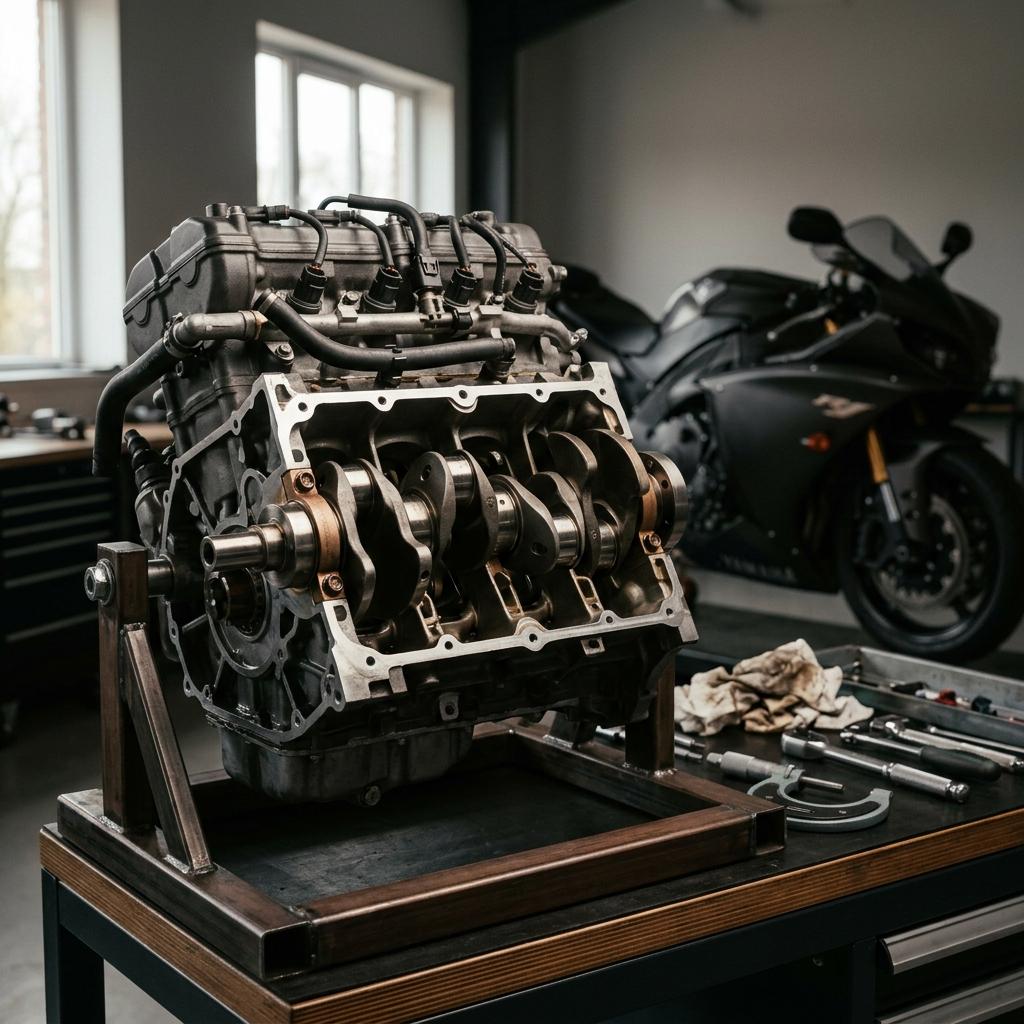
How Yamaha's motorcycle engineers borrowed MotoGP technology to create the most revolutionary superbike in a generation.
The world of 1000cc superbikes is defined by a relentless, cutthroat pursuit of speed. Manufacturers constantly chase more horsepower, less weight, and faster lap times. However, in 2009, Yamaha decided that the pursuit of raw horsepower was resulting in motorcycles that were too aggressive and difficult for human riders to actually control. They introduced a motorcycle that fundamentally changed the trajectory of sports bike engineering by focusing on the quality of power delivery rather than just the quantity. That motorcycle was the crossplane Yamaha YZF-R1.
Revolutionizing Superbikes
Prior to 2009, the Japanese "Big Four" (Honda, Yamaha, Suzuki, Kawasaki) relied almost exclusively on standard inline-four cylinder engines (the "screamer" configuration). These engines produced massive top-end power but had a peaky, aggressive power delivery that often overwhelmed the rear tire mid-corner, causing violent "high-side" crashes.
Yamaha looked to their MotoGP prototype racing program—specifically the YZR-M1 ridden by the legendary Valentino Rossi—for a solution. They decided to bring MotoGP engine technology to the street by completely redesigning the engine's crankshaft.
The Crossplane Crankshaft
The defining innovation of the 2009 Yamaha R1 was the "Crossplane" crankshaft. In a traditional inline-four engine, the pistons move in pairs (two up, two down), firing at even 180-degree intervals. This creates high inertial torque, which interferes with the torque actually produced by combustion, resulting in a sudden, jerky power delivery.
Yamaha’s engineers positioned the crank pins at 90-degree intervals (forming a cross shape when viewed from the end). This results in an uneven firing order (270-180-90-180 degrees). The brilliance of this design is that it almost completely eliminates inertial torque. The power the rider asks for at the throttle grip is exactly the power delivered to the rear wheel. It creates an incredibly direct, linear connection between the throttle and the rear tire, allowing the rider to confidently dial in power mid-corner without fear of sudden wheelspin.
YZR-M1 DNA
Because of the uneven firing order, the crossplane R1 sounds entirely different from any other inline-four motorcycle. Instead of a high-pitched scream, it produces a deep, throaty, guttural growl that closely resembles a V4 engine. This sound is practically identical to Valentino Rossi’s championship-winning YZR-M1 race bike.
While the 2009 R1 was heavier and slightly less powerful on paper than its competitors from Suzuki or Kawasaki, it dominated racetracks worldwide, including winning the World Superbike Championship (WSBK) with Ben Spies. It proved that usable, controllable torque was vastly superior to peaky, unusable horsepower.
Valentino Rossi's Influence
The development of the crossplane engine was heavily influenced by Valentino Rossi. Rossi, known for his incredible feel for rear-wheel traction, championed the crossplane design in MotoGP because it felt "sweet" and saved the rear tire over race distance. Yamaha capitalized on this connection, using Rossi heavily in the marketing for the street-legal R1, cementing its status as a true race replica for the road.
The Electronics Package
As the R1 evolved into its modern iterations (specifically the 2015 overhaul and beyond), Yamaha paired the brilliant mechanical crossplane engine with highly advanced electronics.
Modern R1s utilize a 6-axis Inertial Measurement Unit (IMU) that constantly monitors the bike's pitch, roll, and yaw. This feeds data into a highly sophisticated electronics suite featuring lean-angle-sensitive Traction Control, Slide Control (a first on a production motorcycle), Wheelie Control, and a bi-directional Quickshifter. These electronics act as a safety net, allowing amateur riders to safely exploit the massive 200 horsepower output of the refined 998cc CP4 engine.
The Yamaha R1 remains one of the most uniquely engineered and sonically brilliant motorcycles ever produced. It successfully bridged the massive gap between prototype MotoGP racing and the street, proving that the smartest engineering solution isn't always the one that produces the biggest dyno numbers.
Technical Specifications (2020+ Yamaha YZF-R1)
- Engine: 998cc Liquid-Cooled, Inline-4 with Crossplane Crankshaft (CP4)
- Valvetrain: DOHC, 4 titanium valves per cylinder
- Power Output: 197 hp (147 kW) @ 13,500 rpm
- Torque: 83 lb-ft (113 Nm) @ 11,500 rpm
- Transmission: 6-speed with bi-directional Quickshifter
- Frame: Aluminum Deltabox
- Suspension: Fully adjustable KYB 43mm inverted fork (front), KYB single shock (rear)
- Wet Weight: Approx. 448 lbs (203 kg)
- Electronics: 6-axis IMU, Traction Control, Slide Control, Lift Control, Launch Control
Sarah Velocity
Sarah Velocity is a contributing writer for Primedealsearch, bringing refined insights and expertise to our readers.